The Stories of Pele: Moʻolelo of Hawaiʻi’s Volcano Deity
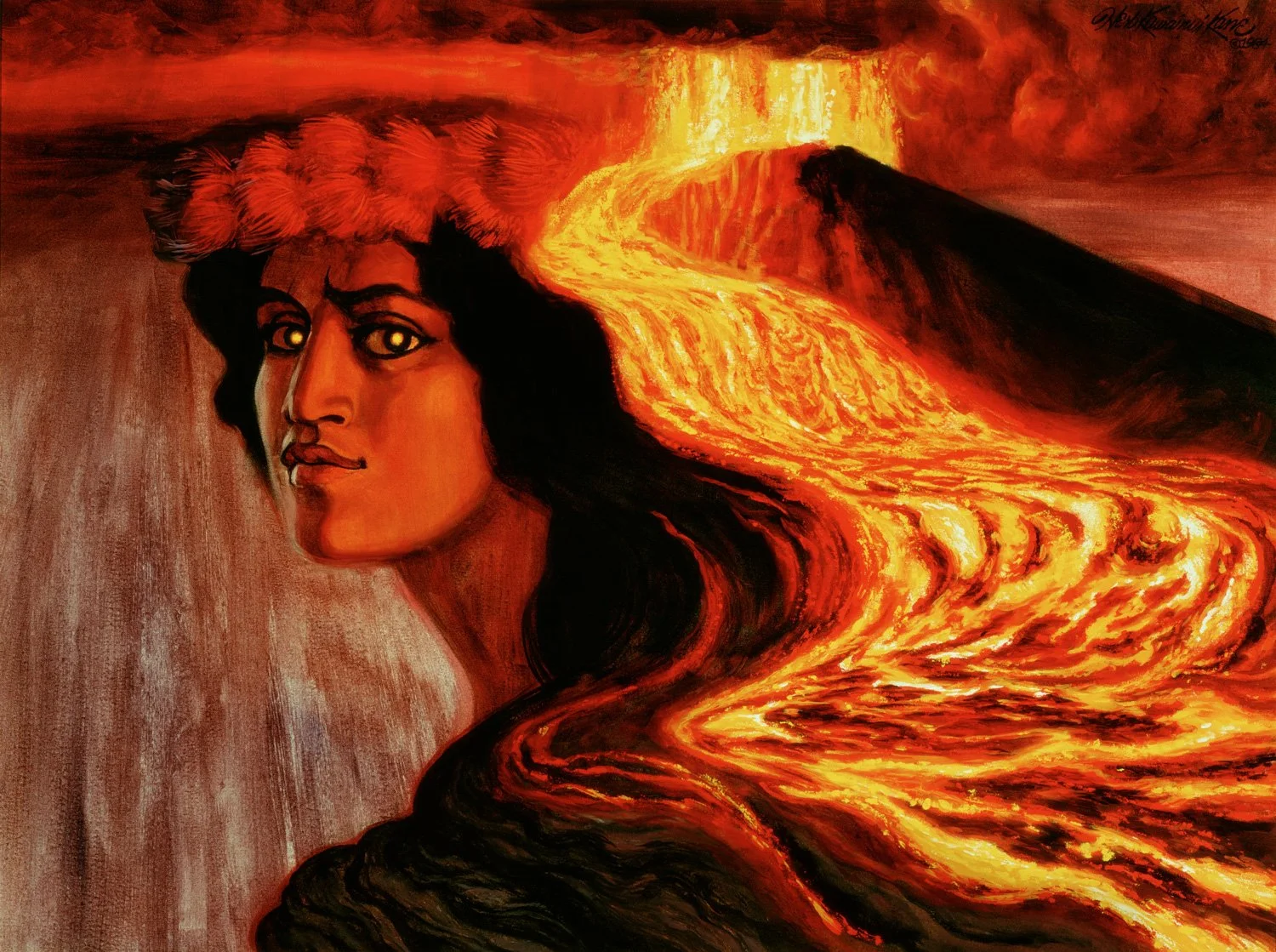
Pele by Herb Kawainui Kāne. Image courtesy of Herb Kawainui Kāne.
Before Hawaiʻi had roads drawn across it or towns marked on maps, stories were already connected to the landscape.
They were carried through generations in moʻolelo (stories, histories, and traditions) and remembered through oli (chants). They became connected to places across the islands, from ridgelines and shorelines to volcanic landscapes shaped by fire.
And among the most powerful figures carried through those traditions is Pelehonuamea.
To simply call Pele the Hawaiian “goddess of volcanoes” leaves much of her story untold.
In Hawaiian tradition, Pele is an elemental volcanic force. She is embodied in lava and the natural forces associated with eruptions. Traditional oli remember a kuleana (privilege & responsibility) that holds creation alongside destruction: her fires can consume what stands before them as volcanic activity creates new land.
But Pele is not only a figure within stories about the distant past.
For some families, Pele is an ʻaumakua (ancestral family deity). Her presence continues to be honored at places such as Uēkahuna at Kīlauea, where Native Hawaiian cultural practices honoring Pelehonuamea continue today.
Her moʻolelo reach across the Hawaiian Islands.
They carry Pele from Kahiki as she searches from island to island for a place where her fire can endure. They introduce the members of her ʻohana, including her beloved younger sister Hiʻiakaikapoliopele, whose journey to Kauaʻi became one of the best-known moʻolelo associated with Pele.
Not every telling follows exactly the same path.
Pele's genealogies differ between traditions, just as details of her journeys can change from one telling to another. That variation is part of a body of moʻolelo carried through different generations rather than a single story with one fixed version.
What remains remarkably consistent is the relationship between Pele and place. Her stories are attached to craters and lava fields. They remain in place names and in landscapes where generations of Hawaiians have remembered her presence.
The stories that follow travel through that landscape with Pele—from her search for a home to encounters remembered long after she found one at Kīlauea. And along the way, the land itself becomes part of the story.
It is also important to note that while Pele is one of the most powerful and widely recognized akua wahine (female deities) in Hawaiian tradition, she is not the only one. Poliʻahu, for example, is an akua wahine associated with the snow and cold of Maunakea, with her own body of moʻolelo connected to the mountain and the people around her. In this blog, however, we will be following the stories of Pele.
Read on to discover some of the moʻolelo of Pele and follow her journey across the Hawaiian Islands.
🌋
〰️
🌋 〰️
Pelehonuamea: Searching for a Home
Long before Pele made her home at Kīlauea, the moʻolelo tell of her as a voyager.
Her journey began across the ocean in Kahiki, a Hawaiian term used for ancestral lands beyond the Hawaiian archipelago.
In one telling preserved by the National Park Service, Pele's elder sister Nāmakaokahaʻi feared the growing mana (spiritual power or authority) of Pele. After Pele accidentally burned sacred lands in their homeland, Nāmakaokahaʻi pursued her. Pele was told by her parents to leave and find a safe home for the family.
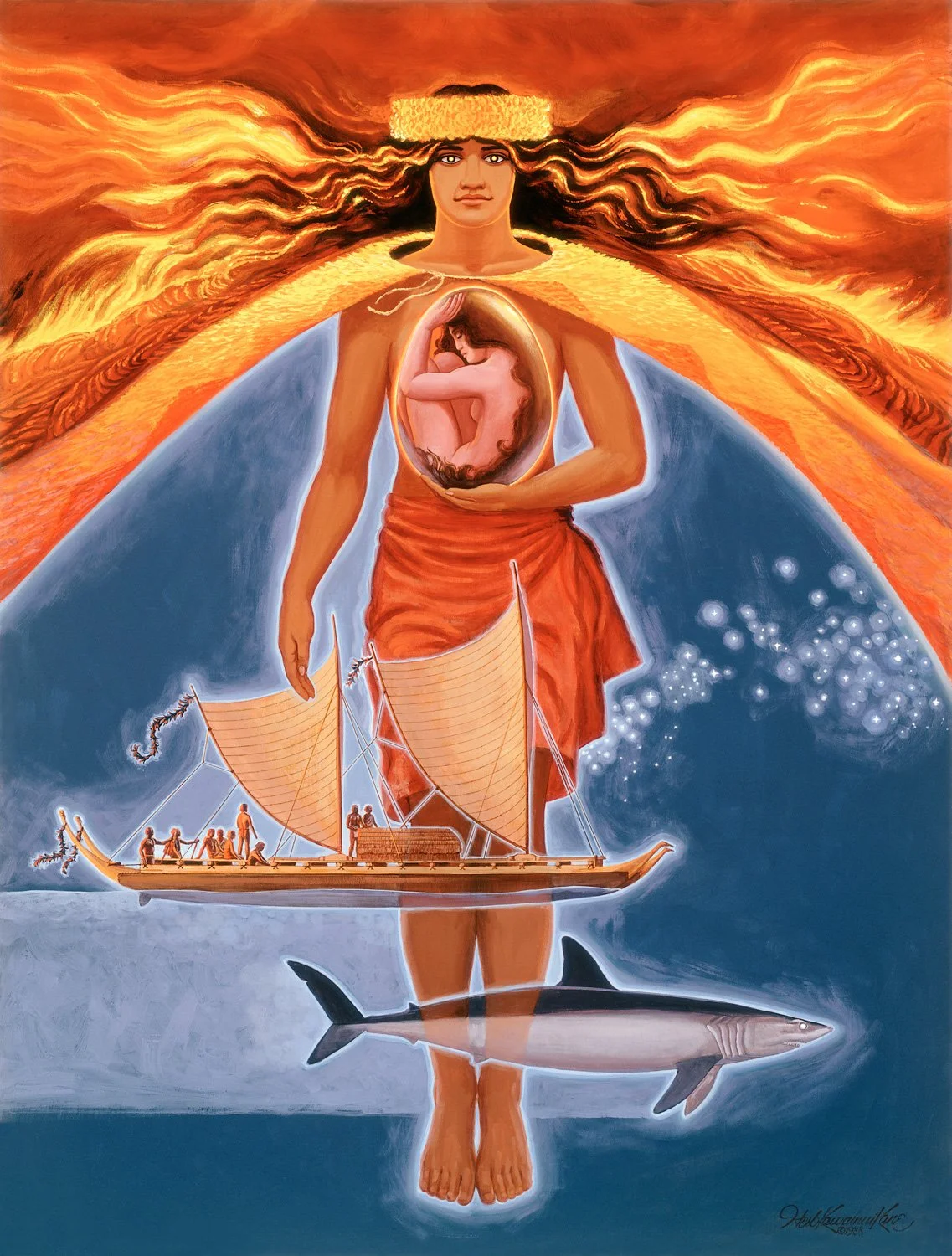
Pele’s Voyage to Hawaiʻi by Herb Kawainui Kāne. © Bishop Museum. Image courtesy of Herb Kawainui Kāne.
Pele did not leave alone. Her family traveled aboard the voyaging canoe Honuaiakea, aided by her eldest brother Kamohoaliʻi. Pele also carried her youngest sister, Hiʻiakaikapoliopele, in the form of an egg.
With her was Pāoa, a digging stick of great mana given to her by her uncle Lonomakua. Pele would use it again and again as she searched for a place where her fire could endure.
Their voyage eventually brought them to Kauaʻi. There, Pele dug into the earth and kindled her fire. But Nāmakaokahaʻi was still pursuing her. The sea overwhelmed Pele's new fire, forcing the family onward.
On Oʻahu, Pele tried again. In this telling, she dug at Leʻahi, the volcanic crater widely known today as Diamond Head. Salt water rose into the opening and drowned her flames. Still, Pele continued.
Her journey carried her onward through the islands until the conflict with Nāmakaokahaʻi reached Maui. On the slopes of Haleakalā, the sisters fought. Nāmakaokahaʻi tore apart Pele's physical body, and the broken lava formations associated with that struggle became known as Nā Iwi o Pele, the bones of Pele.
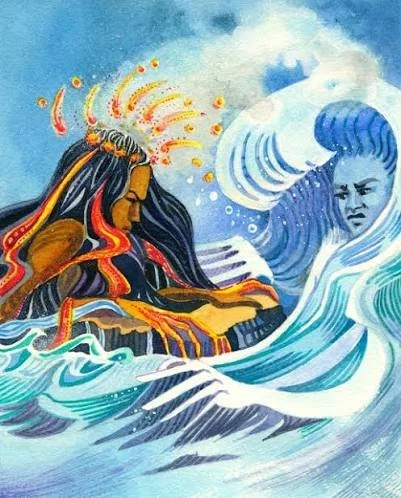
An illustration of Pele and Nāmakaokahaʻi, whose conflict is remembered throughout Pele's journey across the Hawaiian Islands. Courtesy of the Hawaiian Volcano Observatory, U.S. Geological Survey.
Yet Pele was not gone. Nāmakaokahaʻi looked toward Hawaiʻi Island and saw volcanic fire. In the moʻolelo, she understood that Pele's ʻuhane (spirit) had continued onward.
Pele eventually reached Kīlauea. There she tested the earth once more with Pāoa. This time, the signs were favorable.
At Halemaʻumaʻu, Pele had found the home where tradition says she remains.
There is a striking parallel between the direction of Pele's journey and the geological history of the archipelago. Her movement southeast through the islands leads toward the younger volcanic landscapes of Hawaiʻi Island. The National Park Service notes this resemblance while keeping the traditional moʻolelo and geological explanation as distinct ways of understanding the landscape.
But the journey does more than carry Pele from one island to another. It connects her to the land. Places become part of the voyage. Lava can be understood as a kino lau (physical manifestation or form) of Pele. Across the islands, names and formations continue to recall episodes associated with her journey.
Watch the moʻolelo come to life: Before continuing, watch Pele Searches for a Home to follow Pele's journey across the Hawaiian Islands as she searches for a place where her fire can endure.
Pele Finds Her Home
At Kīlauea, Pele's search was over.
But the stories surrounding her were only beginning.
They would remember Pele as a keeper of fire and a powerful protector. Other moʻolelo would remember the consequences of her anger.
One familiar story begins with two lovers named ʻŌhiʻa and Lehua.
There is an important distinction to make before telling it.
The version most commonly shared today—where Pele becomes jealous of ʻŌhiʻa and transforms the lovers—is described by the National Park Service as a well-known but most likely modern story. Older Hawaiian traditions preserve other accounts of the origin of the ʻōhiʻa tree.
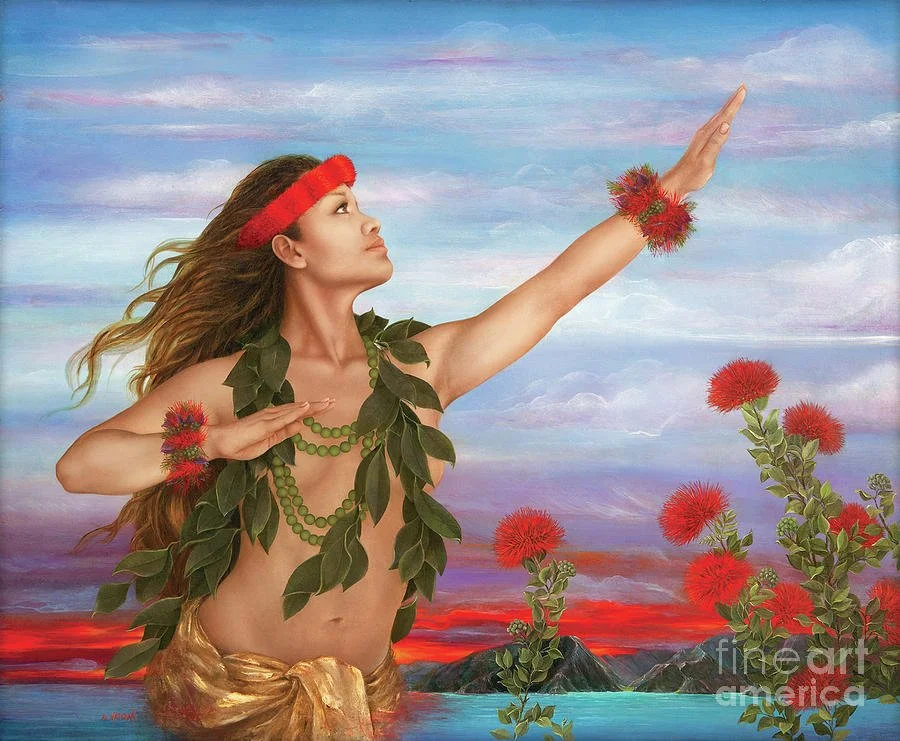
Ohia and Lehua by Lori Higgins. Oil on wood. Image © Lori Higgins.
In the familiar modern telling, ʻŌhiʻa is a handsome young man who attracts Pele's attention.
But ʻŌhiʻa loves Lehua.
When he refuses Pele, she transforms him into an ʻōhiʻa tree. Lehua is left grieving until the other akua (deities or divine beings) find a way to reunite the lovers, transforming her into the lehua blossom that grows upon the tree.
Together they become ʻōhiʻa lehua.
Another part of the popular telling says that plucking a lehua blossom separates the lovers and brings rain as their tears.
It is a beautiful story, but its likely modern origins matter. Hawaiian traditions surrounding ʻōhiʻa extend far beyond this particular version, and older moʻolelo preserve different explanations for the tree.
What does reach much deeper is the relationship between ʻōhiʻa and volcanic land.
ʻŌhiʻa lehua is deeply significant within Native Hawaiian culture, appearing throughout moʻolelo and oli. Its presence across volcanic landscapes also makes the tree inseparable from places shaped by Pele.
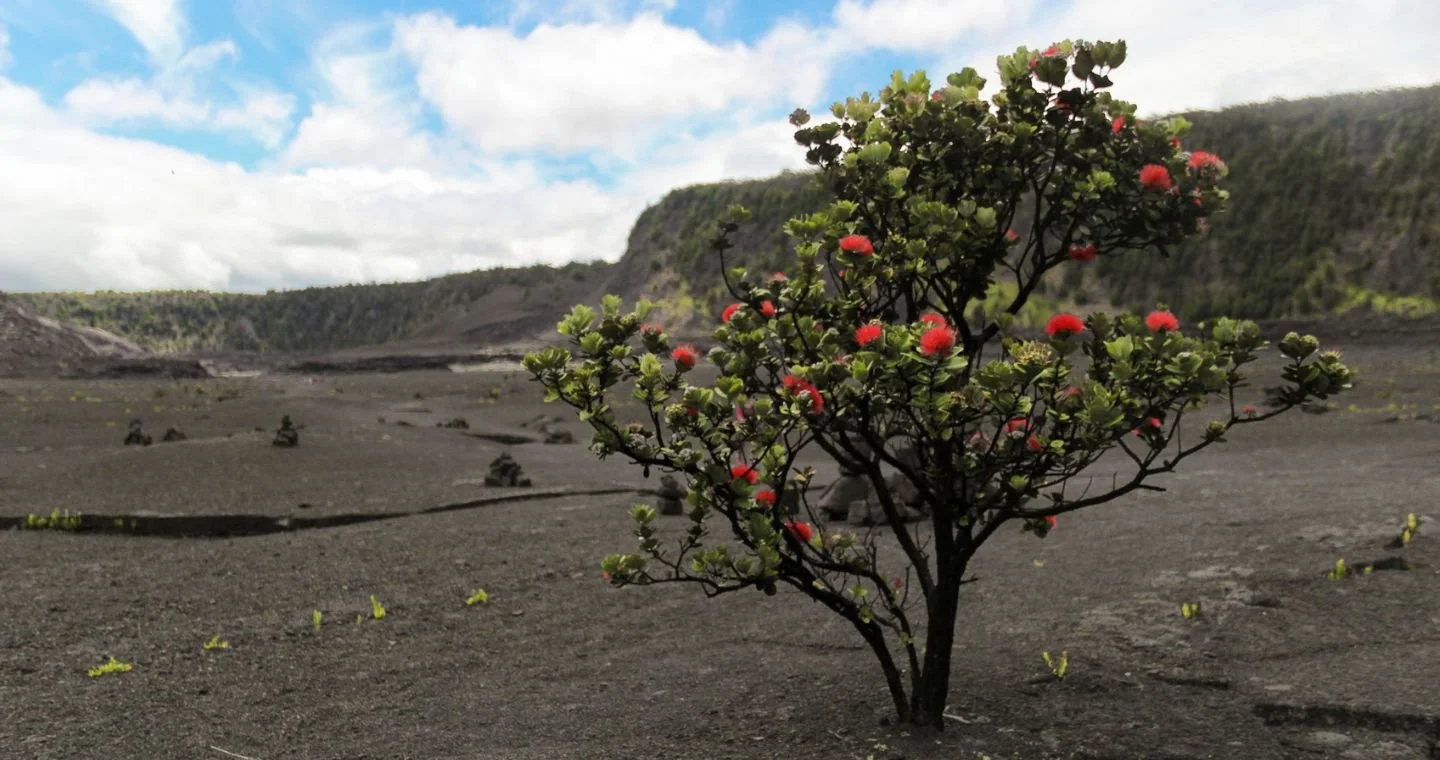
ʻŌhiʻa lehua at Hawaiʻi Volcanoes National Park. Photo courtesy of Volcano Village Estates.
From there, another ʻōhiʻa grove leads us into a much older and far larger Pele tradition.
This one belongs to Hiʻiaka.
Hiʻiaka: A Promise Between Sisters
One of the great Pele sagas begins with a man on Kauaʻi. His name was Lohiʻau.
From her home at Kīlauea, Pele longed for him and asked her sisters to make the difficult journey to Kauaʻi to bring him back.
They refused. All except Hiʻiakaikapoliopele. Pele's youngest and beloved sister agreed to go.
Before leaving, Hiʻiaka asked something in return. Pele was to protect the ʻōhiʻa groves Hiʻiaka treasured in Puna and her beloved friend Hōpoe.
Pele agreed. Then Hiʻiaka set out across the islands. By the time she reached Kauaʻi, she discovered that Lohiʻau had died. But Hiʻiaka had not crossed the islands to turn back.
She found Lohiʻau's wandering spirit and restored it to his body. Lohiʻau lived again, and together they began the long return toward Kīlauea. The journey took time. Too much time for Pele. As the days passed, Pele became convinced that Hiʻiaka had betrayed her with Lohiʻau.
Her suspicion turned toward the promise she had made. Pele burned Hiʻiaka's beloved ʻōhiʻa groves in Puna and covered Hōpoe with lava.
Hiʻiaka, gifted in the story with far sight, saw what had happened. Still, she continued toward Kīlauea.
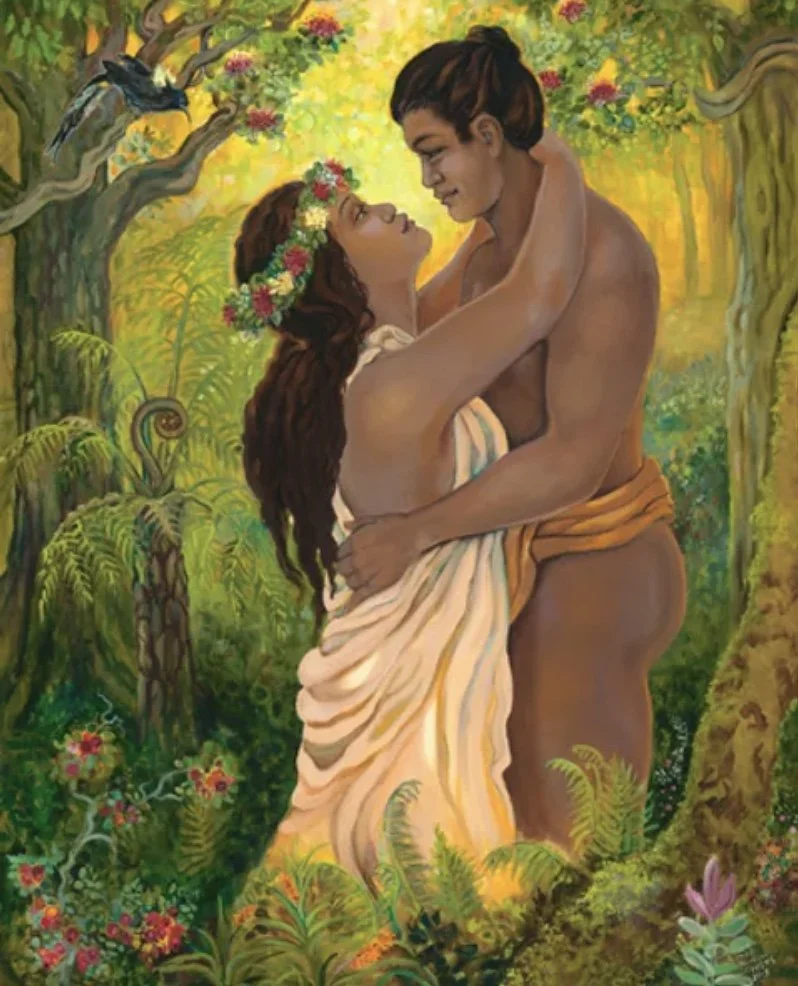
Hiʻiaka & Lohiʻau by Linda Rowell Stevens. Image courtesy of Volcano Art Center.
When Hiʻiaka and Lohiʻau finally reached the caldera, Hiʻiaka embraced him where Pele could see. Pele responded with fury. Her other sisters hesitated when ordered to kill Lohiʻau, so Pele killed him herself.
Now it was Hiʻiaka's anger that threatened Kīlauea. She descended into the crater and began breaking through its layers, intending to release the water held beneath the earth and extinguish Pele's fires. Again and again, the ground broke beneath her.
According to the version preserved by the National Park Service, Hiʻiaka reached the final layer holding back the groundwater. Then she stopped at the last moment, and was dissuaded from destroying Pele's fire. Only then did the sisters reconcile.
It was not an undoing of everything that had happened. Hōpoe and the ʻōhiʻa groves had already been lost, and Pele had killed Lohiʻau in her anger.
But Hiʻiaka did not extinguish the fires of Kīlauea. The story that began with a promise between sisters ends with both of them standing on the other side of its breaking.
Hiʻiaka had crossed the islands for Pele. Pele had failed to protect what Hiʻiaka loved. And when Hiʻiaka finally held the power to destroy what Pele loved in return, she chose not to.
Pele and Lonomakua: Learning to Carry the Fire
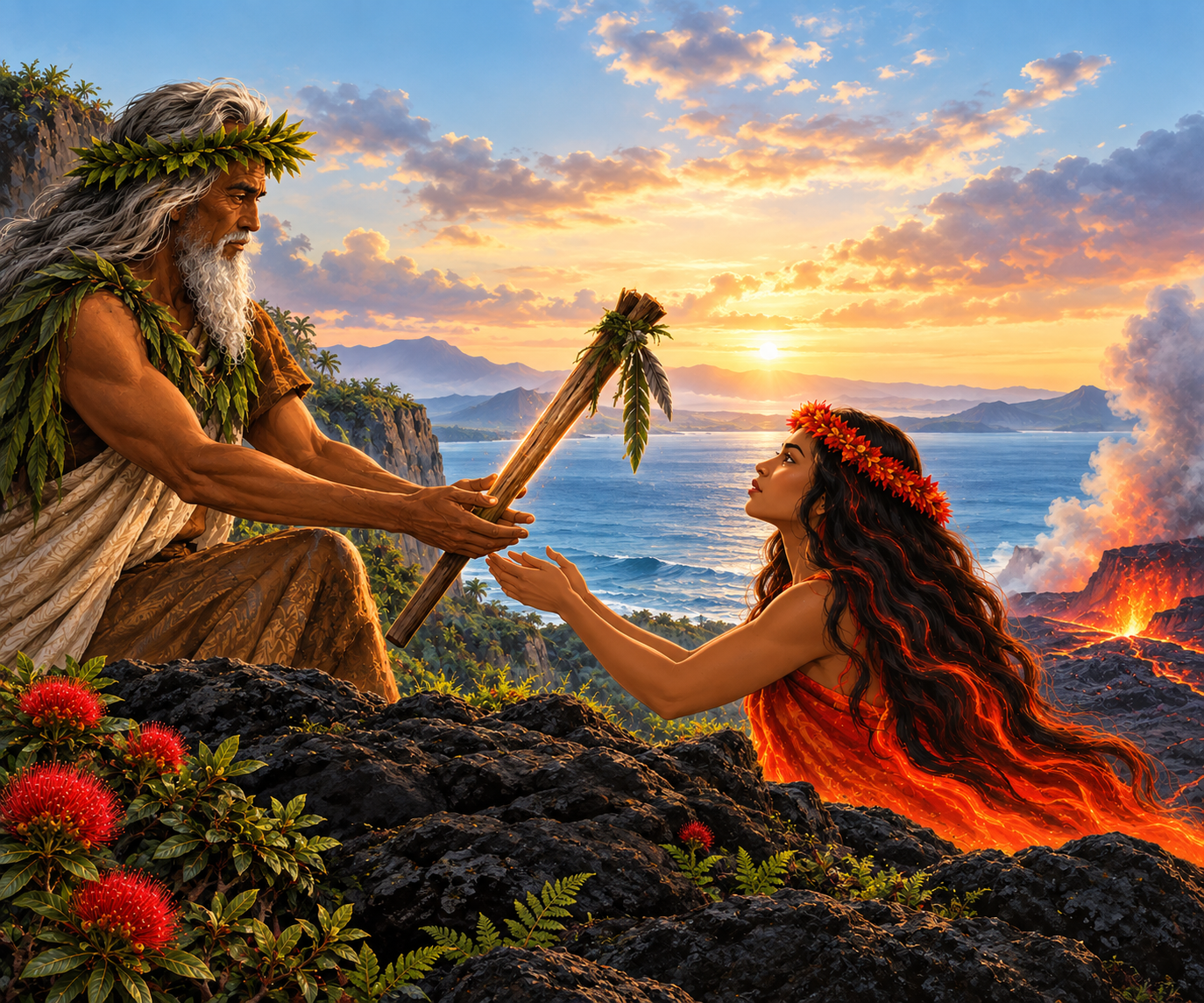
AI-generated image depicting Lonomakua teaching Pele to create and carry fire, passing on knowledge that would become part of her journey across the Hawaiian Islands, courtesy of Trilogy Excursions.
Long before Pele was pursued across islands or challenged by those who crossed her path, there was a time when she was still learning what it meant to carry fire.
Her teacher was her uncle, Lonomakua. When Pele came of age, Lonomakua took her deep underground into the darkness of a lava tube.
There, he taught her about the world around them. For months, Pele listened as he spoke about the movement of the sun and moon. He taught her how freshwater traveled from volcanic mountains toward the ocean and how to recognize the natural forces surrounding them.
Only after Pele had learned these things did Lonomakua decide she was ready for fire.
Lonomakua placed a piece of ʻaunaki, a soft wood used in traditional fire-making, upon the earth. He held an ʻaulima, a hard pointed stick, against it. Then he began to rub.
Lonomakua chanted in the darkness. A spark appeared, and Pele encouraged the fire to grow until the cave was illuminated by flame.
And in that moment, the moʻolelo says, Pele understood her kuleana: to keep the fire burning.
Pele and Kamapuaʻa: When Fire Met Rain
There are forces that even Pele could not simply burn away.
One of them came to Kīlauea in the form of a man.
His name was Kamapuaʻa, which translates to “hog-child,” and Hawaiian traditions remember him as a kupua, a being capable of supernatural transformation. Kamapuaʻa could take different forms. He could appear as a man or as a great hog, and his kino lau (physical manifestations or forms) included plants such as the ʻamaʻu fern. His world was one of heavy rain and the wet forest.
Eventually, his travels brought him to Hawaiʻi Island. And to Pele.
Kamapuaʻa approached Kīlauea and called out to Pele in chant. Pele was unimpressed.
Her sisters noticed the handsome stranger, but Pele dismissed him. Kamapuaʻa persisted. Soon his chants turned into mockery, and Pele answered with insults of her own. Before long the exchange morphed into battle.
Pele called upon the fires of Kīlauea. Volcanic heat and molten rock surged toward Kamapuaʻa, engulfing him in heat.
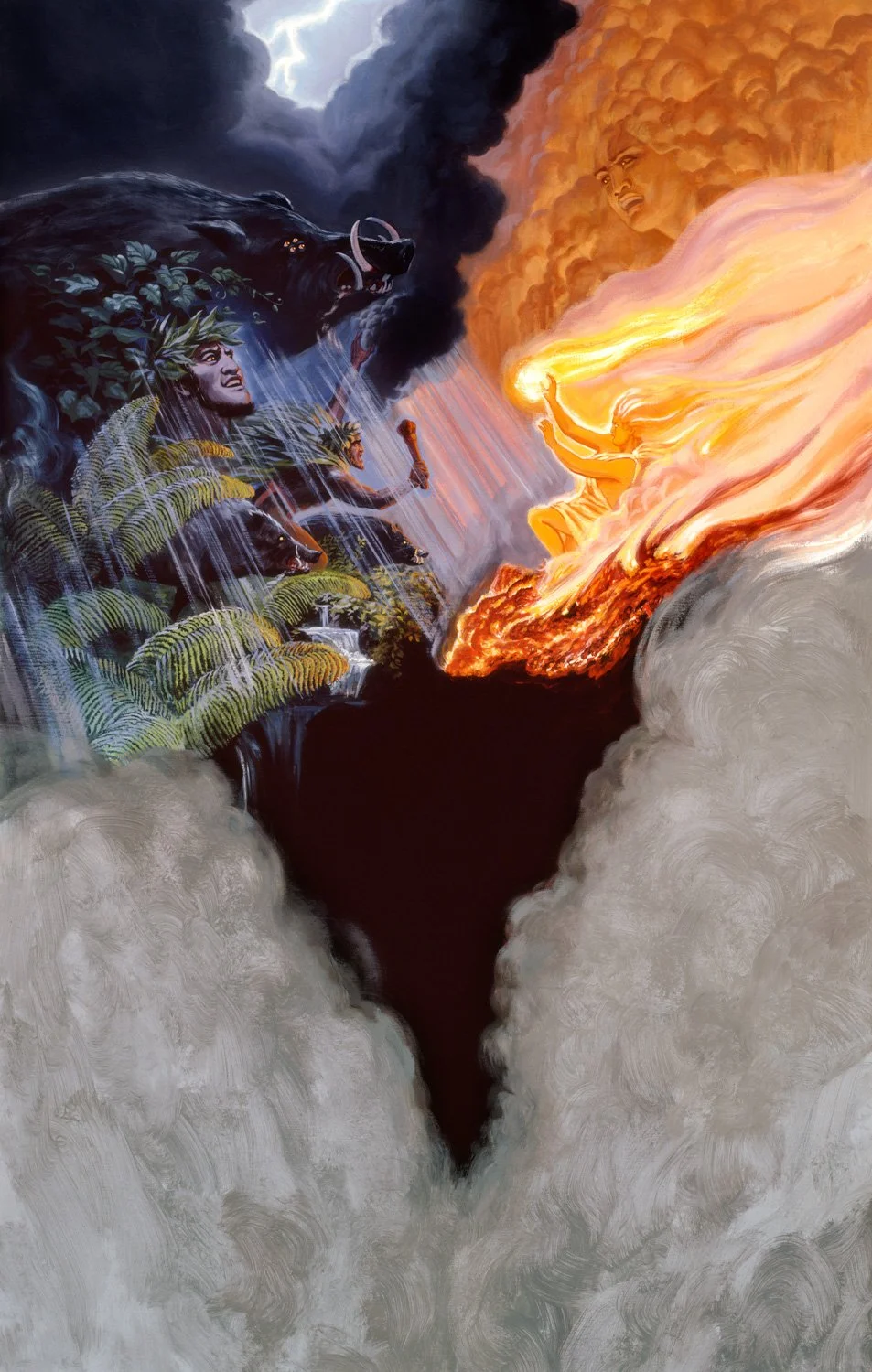
Kamapuaʻa vs Pele by Herb Kawainui Kāne.
However, Kamapuaʻa did not burn. Instead, he called for help.
Kamapuaʻa called to his sister Keliʻiomakahanaloa, who appeared as a small cloud. Then the rain came.
Water poured into the crater until Pele's fires began to disappear beneath it. As Pele and her family struggled to rekindle the flames, Kamapuaʻa transformed into a hog and charged into the crater. He swallowed it whole. Inside him were Pele and her family.
He could have destroyed them. But at the direction of his ʻaumakua, Kamapuaʻa released them. Pele's volcanic flows returned, while Kamapuaʻa answered through his own kino lau, including the ʻamaʻu fern, pushing against her fire. Neither gained the advantage.
Fire advanced. The wet forest resisted. Neither could completely overcome the other.
This is where one recorded story ends and another continues on. In that telling, Pele and Kamapuaʻa eventually reach an agreement. Rather than destroy one another, they divided the land between them.
Kamapuaʻa took the wetter districts of Kohala, Hāmākua, and Hilo. Pele took the drier districts of Kaʻū, Kona, and Puna.
Fire would have its place. So would rain.
Pele and Kahawali: A Race Down the Mountain
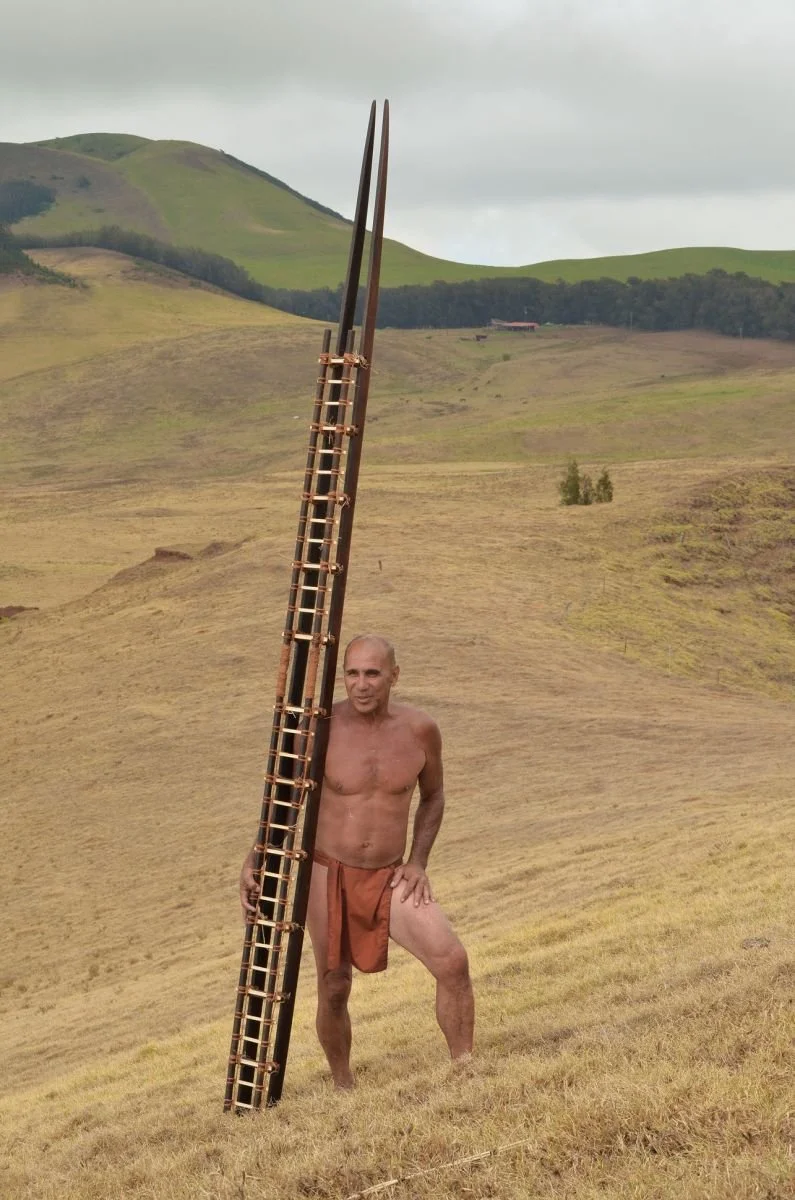
Tom “Pōhaku” Stone holds a traditional papa hōlua on the slopes of the Kohala Mountains on Hawaiʻi Island. Heʻe hōlua is a traditional Hawaiian form of land sledding in which skilled riders descended specially prepared slopes on long, narrow wooden sleds called papa hōlua. The sleds were built with two runners connected by crosspieces and lashings, and riders could descend lying prone or standing.
Image source: Hawaiʻi Magazine.
Not everyone who encountered Pele knew who stood before them. Kahawali certainly didn't.
Kahawali was a chief of Puna on Hawaiʻi Island and a skilled hōlua rider. Hōlua (traditional Hawaiian sledding) was practiced on steep courses, where riders descended the slope on narrow sleds.
One day, Kahawali was riding when an unfamiliar woman appeared and challenged him to race. The woman was Pele, but Kahawali did not recognize her.
Kahawali accepted the challenge. As the more experienced rider, he won the race, and Pele was beaten.
Afterwards, Pele asked Kahawali for his sled. Not only did he refuse, he ridiculed her.
It was a mistake Kahawali would understand almost immediately. As his mockery continued, Pele revealed herself, turning into molten lava. And the race changed.
No longer racing a woman down the hillside, Kahawali was fleeing Pele herself as she pursued him in the form of fire and lava. He fled toward the coast.
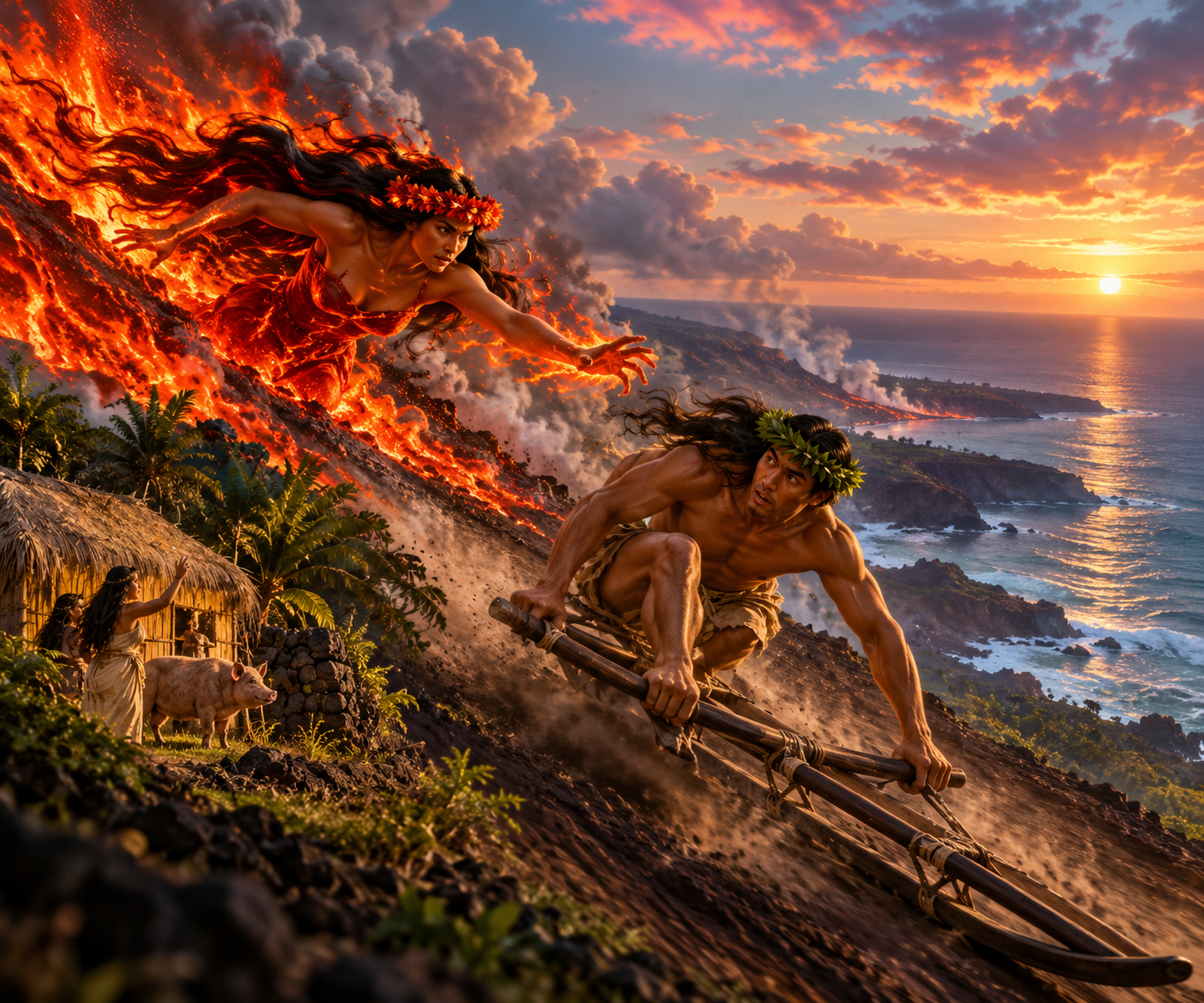
AI-generated image depicting Kahawali fleeing toward the coast on a traditional hōlua sled as Pele pursues him in the form of fire and lava, courtesy of Trilogy Excursions.
Other recorded versions differ in how the encounter begins. In some, Kahawali refuses to race the unknown woman at all. The details shift between tellings, but his desperate flight from Pele remains central to the tradition.
In versions that follow his escape toward the sea, Kahawali passes his home and calls farewell to those he loves, including a favorite pig remembered as ʻĀloʻipuaʻa. Eventually he reaches the coast and escapes Pele's pursuit.
But his story remains at Kīlauea. The name ʻĀloʻi is connected in recorded place-name traditions with Kahawali's pig. Another version carries Kahawali beyond his escape, telling of powerful priests who return with him to challenge Pele. Several of their names—including Uēkahuna and Kaʻauea—became attached to places around Kīlauea.
Pele and Punaʻaikoaʻe: Under Pele’s Protection
Punaʻaikoaʻe was a chief from Oʻahu who encountered a beautiful woman named Kalamainuʻu while surfing at Waimānalo.

AI-generated image depicting Punaʻaikoaʻe encountering the beautiful Kalamainuʻu while surfing at Waimānalo. As he follows her across the water, she reveals her true nature as a moʻo, a powerful shape-shifting being, courtesy of Trilogy Excursions.
Punaʻaikoaʻe followed her across the water to Molokaʻi. There he discovered that Kalamainuʻu was a moʻo—a supernatural shape-shifting being who, in this story, could take the form of a giant lizard. And Punaʻaikoaʻe had become her captive with no way out in sight.
He began scheming, trying to come up with creative ways to escape his prison.
Punaʻaikoaʻe told Kalamainuʻu that he longed for the chilled waters of Poliʻahu from Hawaiʻi Island. Before she left to retrieve them, he secretly made holes in her water gourd. The water escaped as she tried to carry it back, which gave him enough time to flee.
He went straight to Kīlauea and placed himself under the protection of the family of his former wife: the family of Pele.
Pele wanted to protect him. But Kalamainuʻu was enraged that he had escaped her and fiercely wanted him back.
Kalamainuʻu summoned other moʻo from across the Hawaiian Islands. Together, they gathered at the edge of Pele's home and threatened to extinguish the fires of Kīlauea unless Punaʻaikoaʻe was surrendered. However, Pele refused.
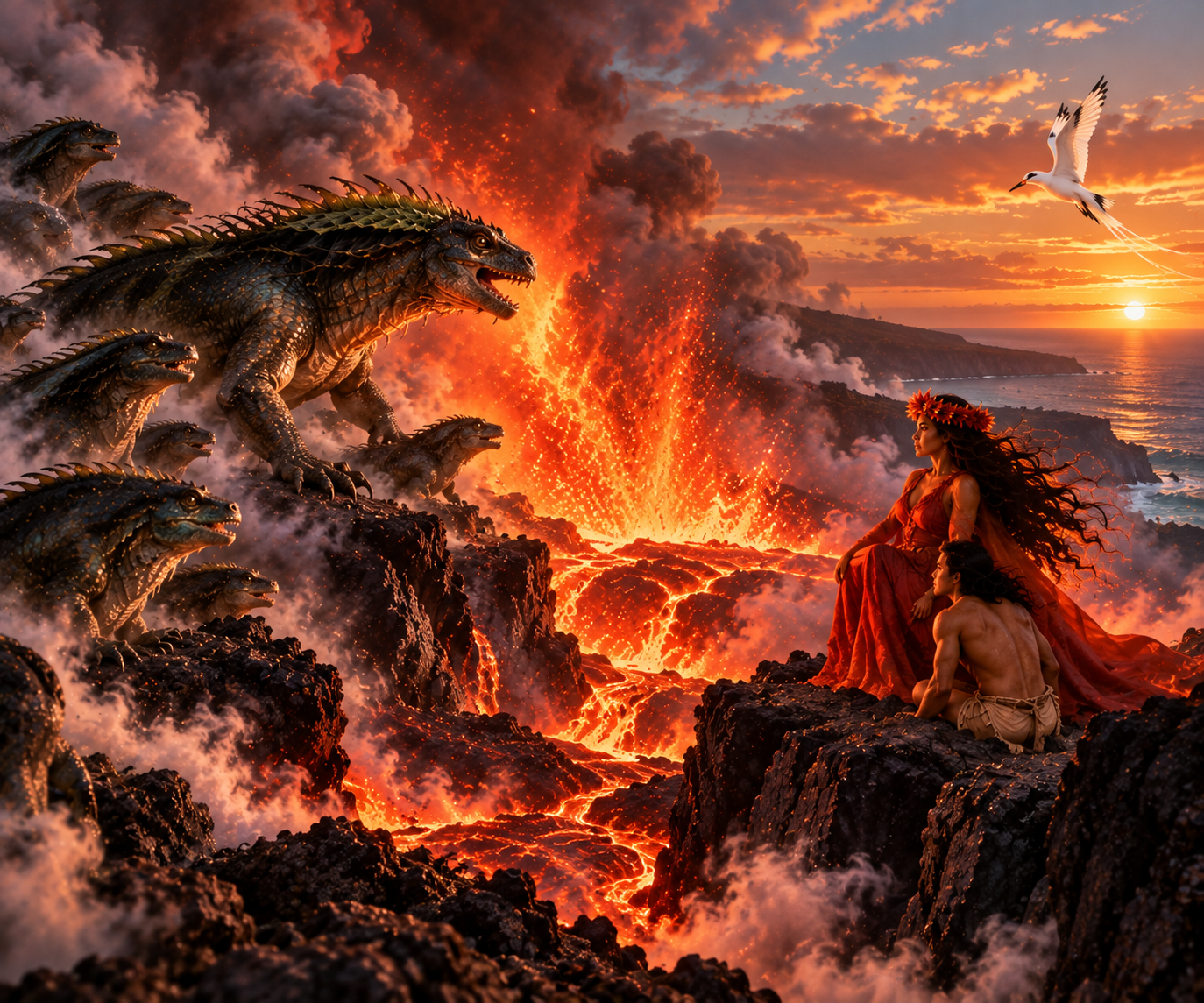
AI-generated image depicting Pele protecting Punaʻaikoaʻe at Kīlauea as Kalamainuʻu and the gathered moʻo confront Pele’s family, with the koaʻe kea soaring above as a kino lau of Punaʻaikoaʻe, courtesy of Trilogy Excursions.
Kalamainuʻu had taken her stand upon Kapalikapuokamohoaliʻi, the sacred cliffs associated with Pele's eldest brother, Kamohoaliʻi.
Heat rose through the earth and the crater erupted around the invading moʻo.
Kalamainuʻu narrowly escaped by plunging into Lokoaka, a pond where she barely survived. Meanwhile, Punaʻaikoaʻe remains within Pele's protection to this day.
His presence remains connected to Kīlauea in another form. The koaʻe kea, or white-tailed tropicbird, is remembered as a kino lau—a physical form—of Punaʻaikoaʻe. The birds still fly above the cliffs of Kīlauea, where the moʻolelo places him safely within Pele's domain.
Pele and the Girl Who Gave Breadfruit
One moʻolelo from Kona tells of Pele traveling through the land disguised as an old woman.
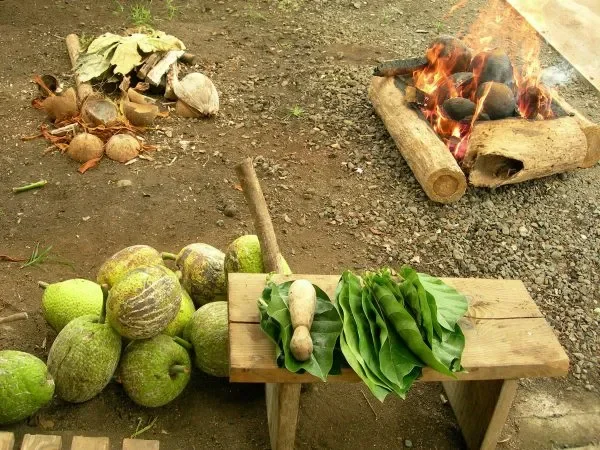
Breadfruit (ʻulu) prepared for traditional cooking over a fire. Photo © Gérard Koch, 2012. Source: Tales of Hawaiʻi.
She came to the village of Manuahi, where most of the people were away working. Two girls remained behind, roasting ʻulu (breadfruit). Their names were Pāhinahina and Kolomuʻo.
The old woman approached them and asked who the breadfruit was for. Kolomuʻo said hers was for Laʻi, the deity of her family.
Then the stranger turned to Pāhinahina, who said her ʻulu was for Pele. Of course, neither girl realized that Pele herself was standing in front of them.
Pele, still disguised as the old woman, told Pāhinahina that their breadfruit was ready to eat. Pāhinahina doubted it—it had not roasted long enough—but when she checked, the ʻulu was indeed cooked and ready to eat.
Pāhinahina shared the meal with the mysterious stranger, and while doing so Pele asked Pāhinahina about her home and her parents. Pāhinahina explained that she and Kolomuʻo lived in the same house, but that each girl stayed on a different side with her own parents.
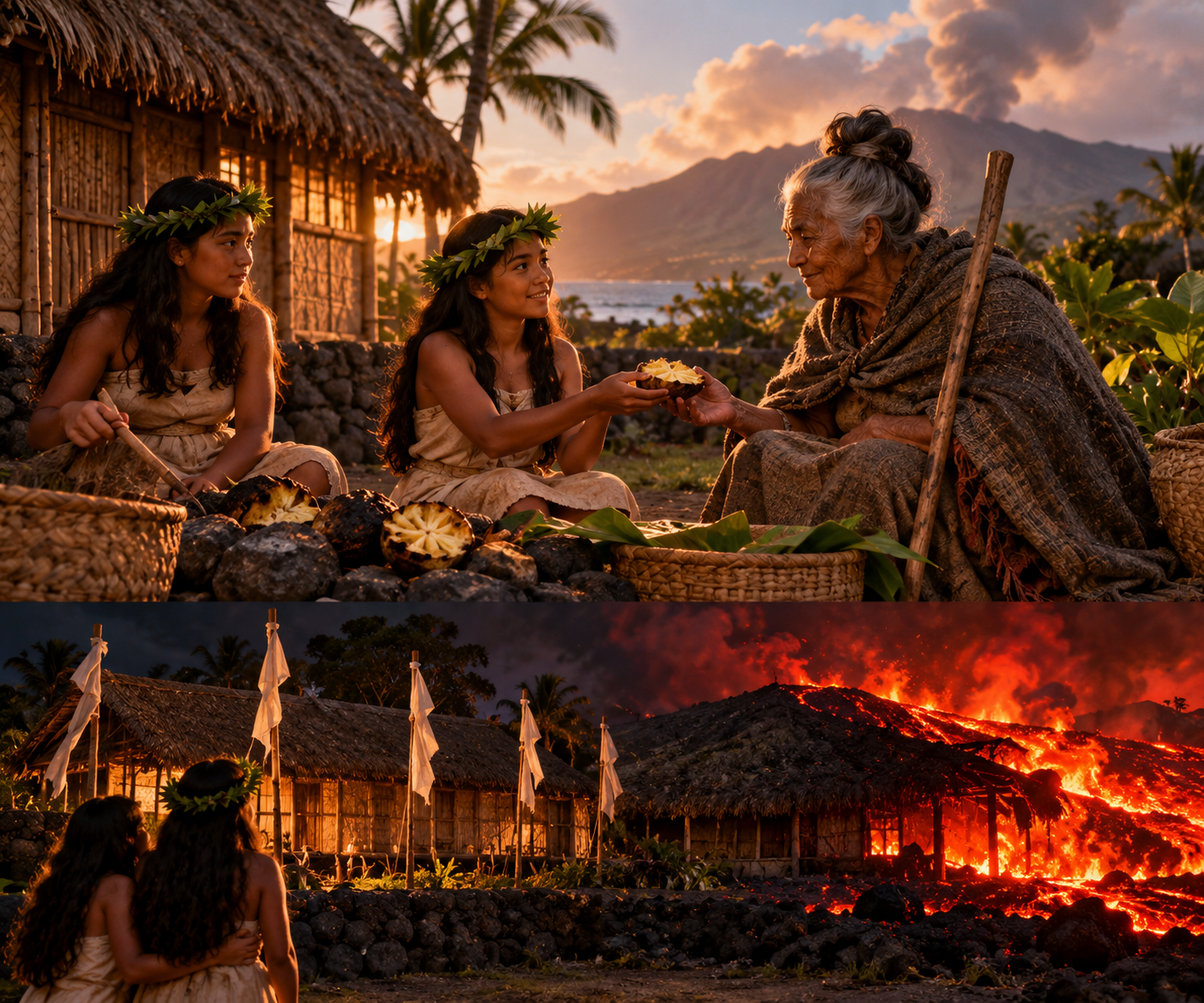
AI-generated image depicting Pāhinahina sharing roasted ʻulu with Pele, who has come to Manuahi disguised as an old woman. Later, lava moves toward the village, while lepa mark the portion of Pāhinahina’s home that Pele spares from the flow, courtesy of Trilogy Excursions.
Before Pele departed, she gave Pāhinahina an unusual instruction. She told her to place lepa (flags or markers) around the part of the home where Pāhinahina and her family lived.
Fire was coming.
That night, lava moved down the mountain and toward the village. When it reached the home of the two girls, the portion belonging to Pāhinahina and her family was spared, while the other side of the house belonging to Kolomuʻo was destroyed. Only then did she realize she had shared her ʻulu with Pelehonuamea herself, who in turn showed mercy to her and her family.
The story was later preserved by Mary Kawena Pukui and Caroline Curtis as “The Girl Who Gave Breadfruit,” while an earlier Hawaiian-language newspaper version of the breadfruit-roasting girls was published in Ka Hoku o Hawaii in 1924.
Pele and the Puna Chief Who Boasted
There was once a chief named Keliʻikuku who was enormously proud of his home in Puna. Wherever he traveled, he boasted of its beauty.
Puna was fertile and flourishing, and Keliʻikuku believed there was nowhere quite like it. However, as his bragging continued, he was warned to be careful when speaking so boldly within the land of Pele.
Keliʻikuku ignored all of these warnings and continued with his travels. This time, heading to Oʻahu. There he encountered Kāneakalau, a prophet of Pele from Kauaʻi. When Kāneakalau asked about his homeland, Keliʻikuku once again began boasting of Puna’s flourishing beauty. Upon hearing this, Kāneakalau immediately told him to return home. The Puna he remembered, he warned, would no longer be there.
With his gift of sight, he knew that Pele had covered the land, but Keliʻikuku, in denial, refused to believe him.
However, unable to shake his words, doubt began to set in, and the chief set out for Hawaiʻi Island to see for himself.
As Puna came into view, so did the smoke. The fertile land he had praised so proudly had been covered by lava. Forests burned, and the landscape he remembered had been transformed. The land Keliʻikuku loved had not ceased to be Puna, but it was no longer the same Puna he had boasted of.
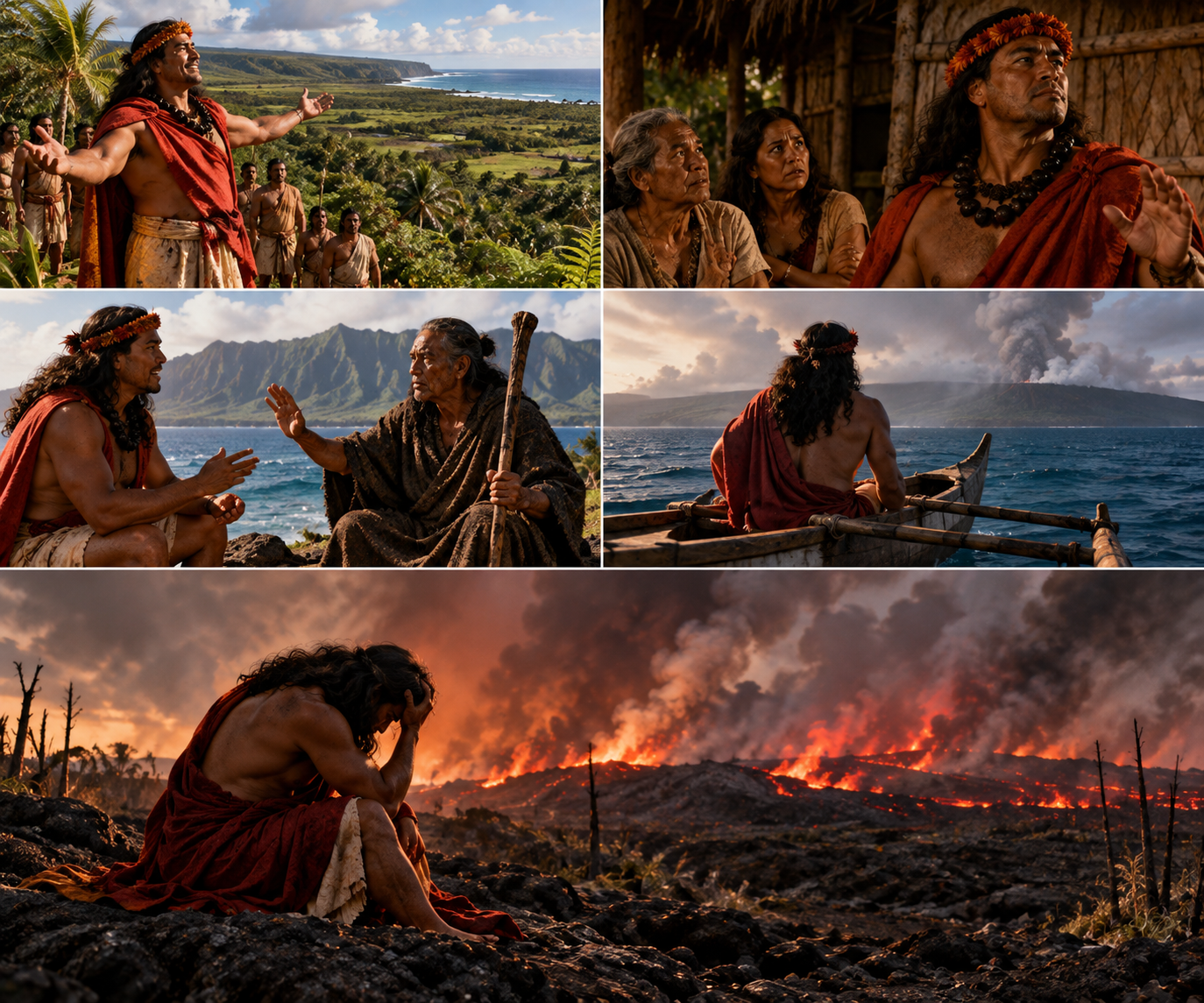
AI-generated image depicting the moʻolelo of Keliʻikuku, the Puna chief who boasted of his flourishing homeland despite warnings to respect the land of Pele. After Kāneakalau warns him to return home, Keliʻikuku journeys back to Hawaiʻi Island and finds the Puna he remembered transformed by fire and lava, courtesy of Trilogy Excursions.
In W. D. Westervelt's recorded version, the sight overwhelms Keliʻikuku and he takes his own life. Mary Kawena Pukui and Caroline Curtis later preserved the tradition under the title “The Puna Chief Who Boasted.” The UH Mānoa Hawaiian Legends Index records their version on pages 49–50 of Hawaii Island Legends: Pikoi, Pele and Others.
Pele and the Pounded Water of Kekela
Another story from Kona begins during a drought. An elderly couple lived there with their dog, and like everyone around them, they felt the effects of the dry conditions. Water had become desperately important. One day, something quite unusual happened. Their dog returned home to them, soaking wet.
Unable to figure out how the dog had managed to become drenched in freshwater, the couple decided to follow their dog. Their curiosity was rewarded as the dog led them to a hidden source of freshwater deep within a cave surrounded by lava rock.
They understood this discovery as a gift from Pele herself.
The couple brought word to their chiefess, Kekela, and people were sent to reach the water. But reaching it was not an easy feat.
According to traditions associated with the place, basalt was heated and pounded through so the freshwater source beneath could be opened.
The water became known as Ka Wai Kuʻi o Kekela — the Pounded Water of Kekela.
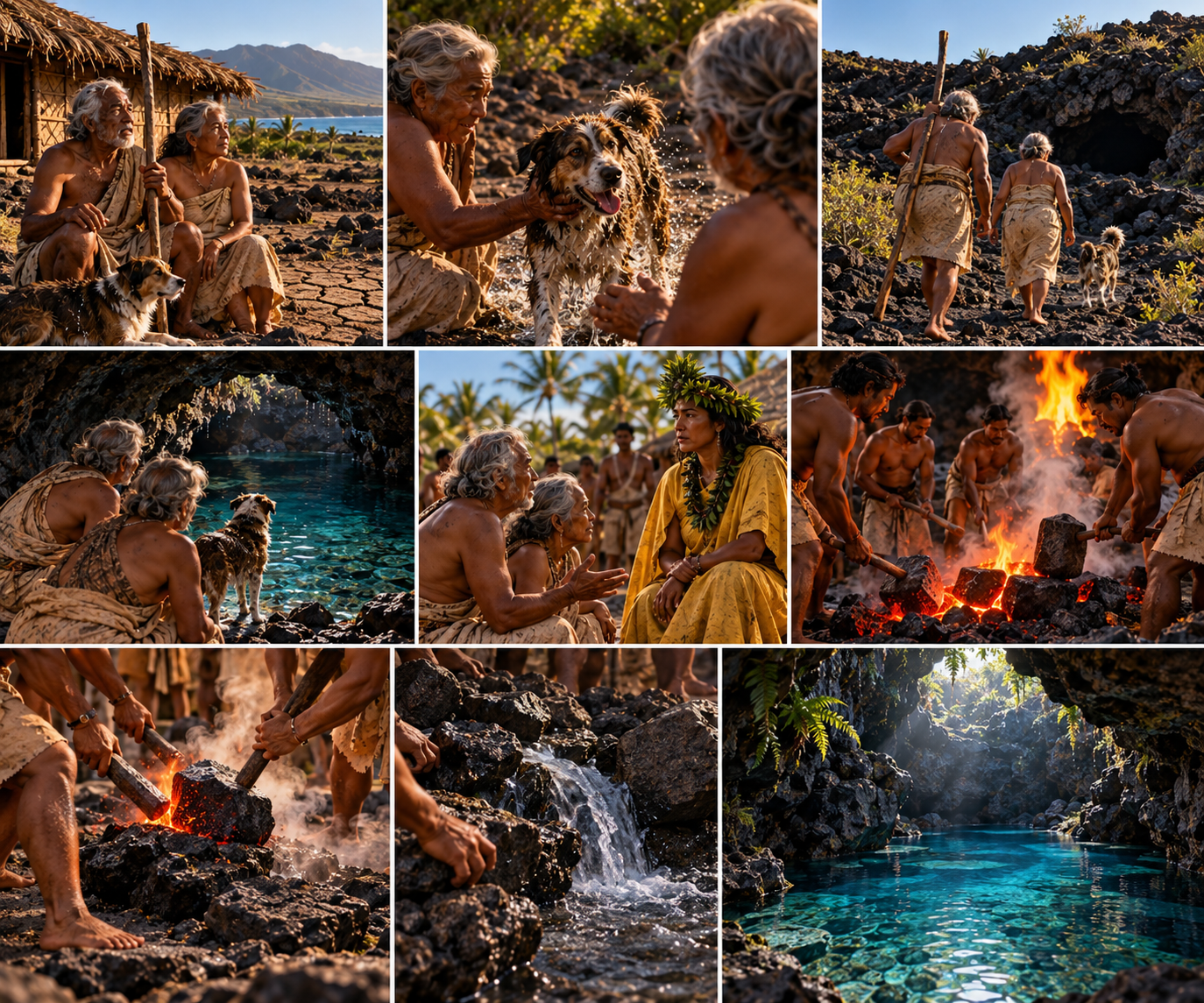
AI-generated image depicting Ka Wai Kuʻi o Kekela — the Pounded Water of Kekela. An elderly Kona couple discovers that their dog has returned wet and follows it across the dry lava landscape to a hidden freshwater source. After they bring word of the discovery to Chiefess Kekela, people use fire to heat the basalt and pound through the rock to reach the water below, courtesy of Trilogy Excursions.
Mary Kawena Pukui and Caroline Curtis preserved the story under that name in Hawaii Island Legends: Pikoi, Pele and Others, where the UH Mānoa Hawaiian Legends Index places it in Kona and connects it with caves and water.
When Pele Came Toward Hilo
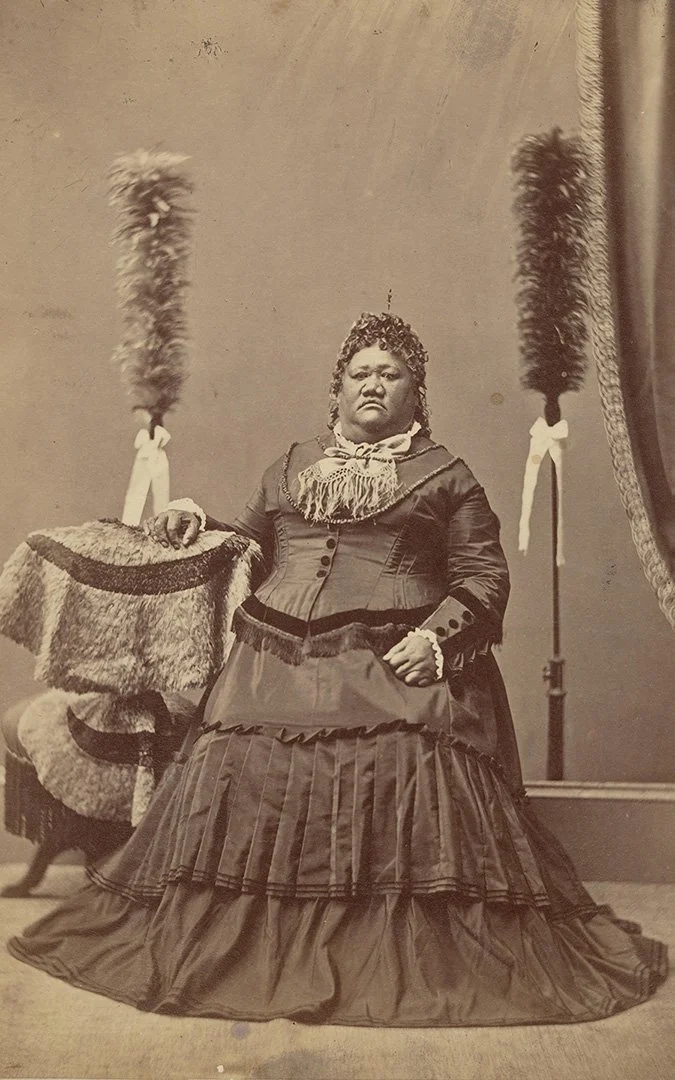
Princess Ruth Keʻelikōlani. Photograph by Menzies Dickson. Hawaiʻi State Archives, General Photographic Collection, PP-97-18-007, HC 30,184.
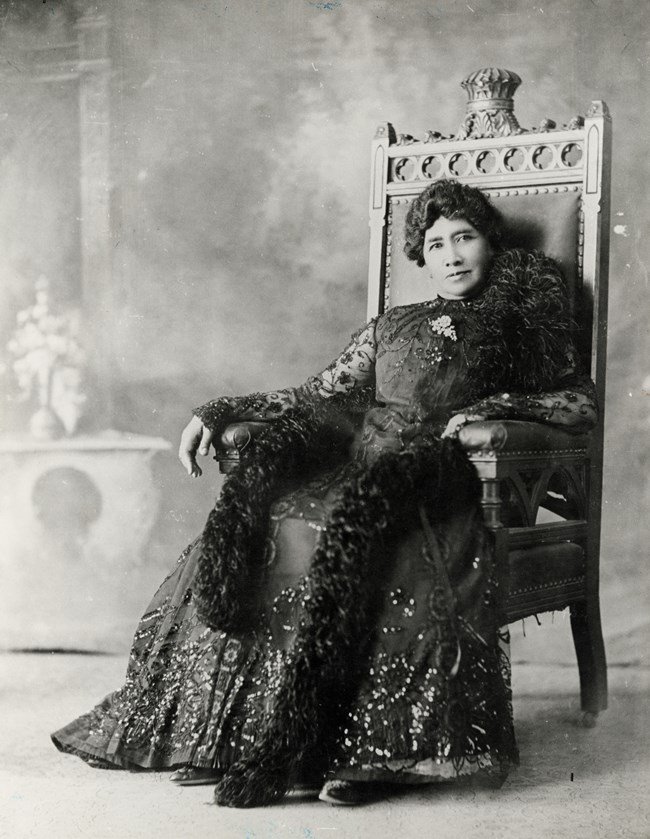
Queen Liliʻuokalani, 1900. Hawaiʻi State Archives, General Photographic Collection, PP-98-13-019.
The stories of Pele do not end in an ancient past.
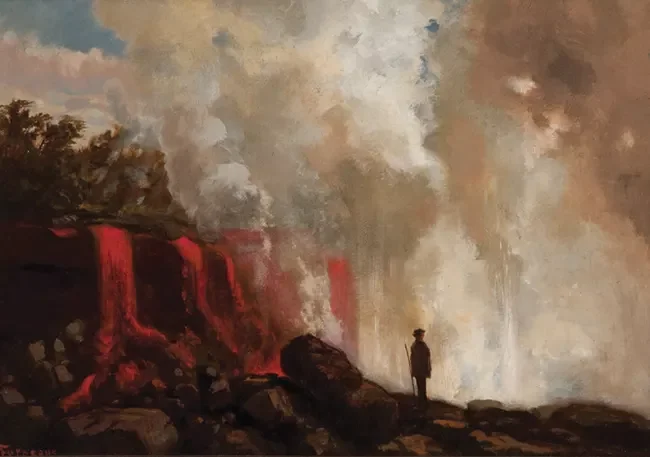
1881 lava cascade in Kūkūau Gulch near Hilo, Hawaiʻi Island, by Charles Furneaux. Hawaiʻi Volcanoes National Park archives, catalog no. HAVO 808. Source: National Park Service.
In 1881, lava from Mauna Loa had been advancing toward Hilo for months. By summertime, fear was growing. The lava had moved close enough to threaten the town, and people tried different ways of responding to it with no luck.
That August, Princess Ruth Keʻelikōlani arrived on Hawaiʻi Island with Queen Liliʻuokalani.
Keʻelikōlani was one of the highest-ranking aliʻi of her time and was known for maintaining traditional Hawaiian cultural practices. When she came to Hilo, she did not approach the advancing lava simply as a geological event. She approached Pele.
At the foot of the flow, Keʻelikōlani performed oli (chants) and presented hoʻokupu (offerings) to Pele. Later accounts reported that she was appealing to Pele to return home and spare her people. Then she waited.
Soon afterward, the lava flow stopped advancing. Some reports credited Keʻelikōlani's intervention, and the National Park Service records that she may then have camped overnight just beyond the lava's reach.
The historical moment matters because of what it reveals about the continuing relationship with Pele.
In 1881, an aliʻi did not treat her as a character whose relevance belonged only to old stories, but as an akua still present, still active. And Pele responded in kindness.
Signs of Pele: Where Her Stories Remain on the Land
After hearing the stories of Pele, it becomes difficult to look at the Hawaiian Islands quite the same way.
Her moʻolelo (stories, histories, and traditions) are not confined to something that happened in an undefined ancient past. Across the islands, particular hills and craters remain connected to the places where her stories unfolded.
Some of those connections are preserved in well-documented Hawaiian traditions. Others are stories whose beginnings are much harder to trace.
But together, they reveal something important about Pele: her story is remembered through the land itself.
The X Above Nuʻalolo Kai — Kauaʻi
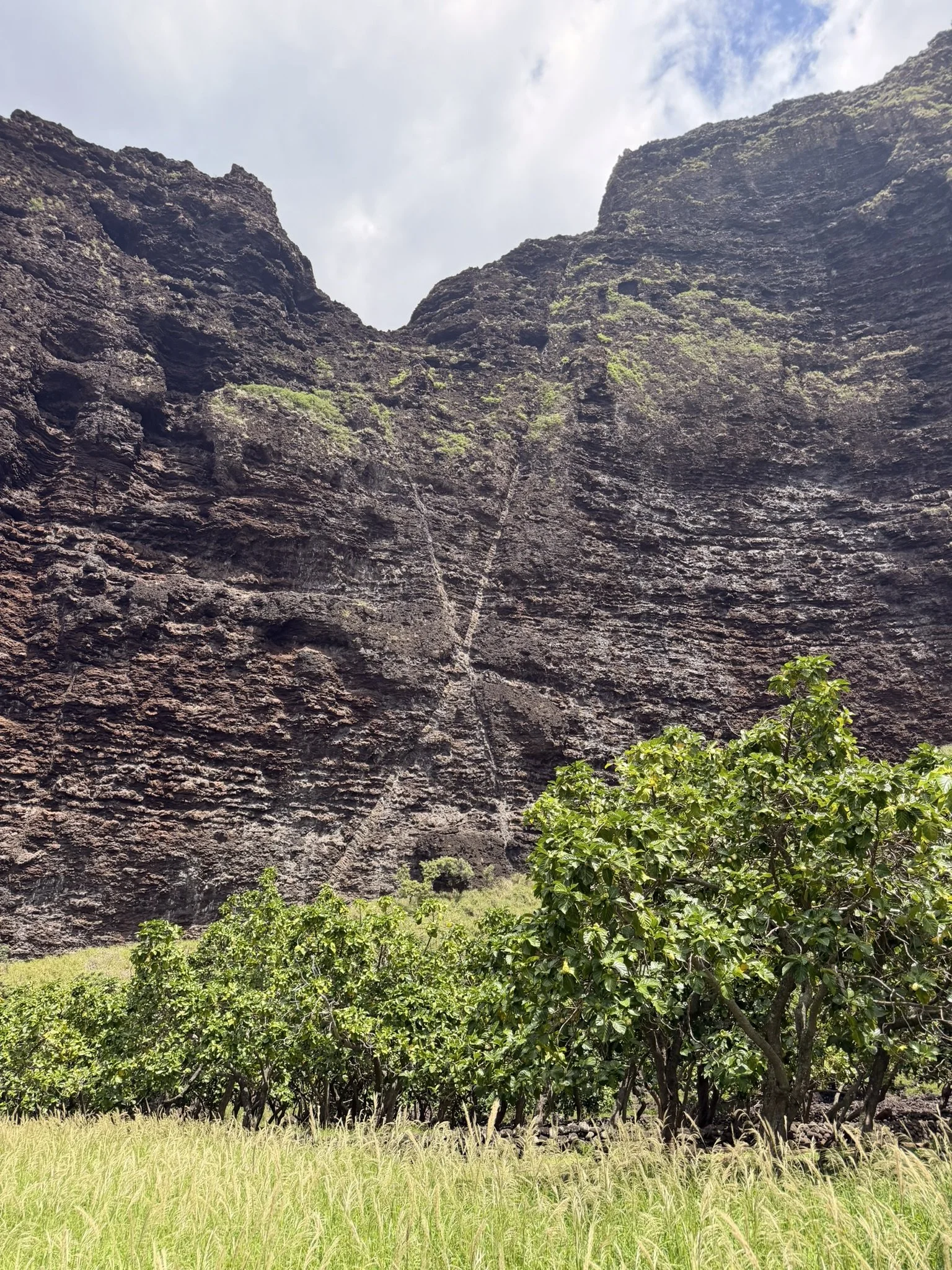
Photo courtesy of Curran Jones
Along the Nāpali Coast of Kauaʻi, high above Nuʻalolo Kai, two prominent lines cross the pali (cliff), creating what looks like a large X when viewed from offshore.
Below it lies Nuʻalolo Kai, a traditional Hawaiian fishing village and one of the significant archaeological sites along the Nā Pali Coast. Archaeological research has documented generations of Hawaiian life here, with remains of homes and other cultural features still preserved along the coastal flat.
Look high above the settlement, however, and a more recent story has become attached to the cliff.
The X is sometimes called “Pele’s signature,” with the formation described as a mark Pele left upon Kauaʻi during her journey through the islands. Some locals claim today that the signature left behind, was her way of marking Kauaʻi as her masterpiece.
It is an easy image to remember: before continuing her search for a home, Pele leaves what looks like her signature across the pali.
But unlike the older Pele moʻolelo shared throughout this article, the origins of this story are unclear. The documented archaeological history of Nuʻalolo Kai does not establish the X as an ancient mark of Pele.
So while “Pele’s signature” remains a story associated with the formation today, it is best understood separately from the older recorded traditions of Pele's journey.
Pele's Search Across Oʻahu
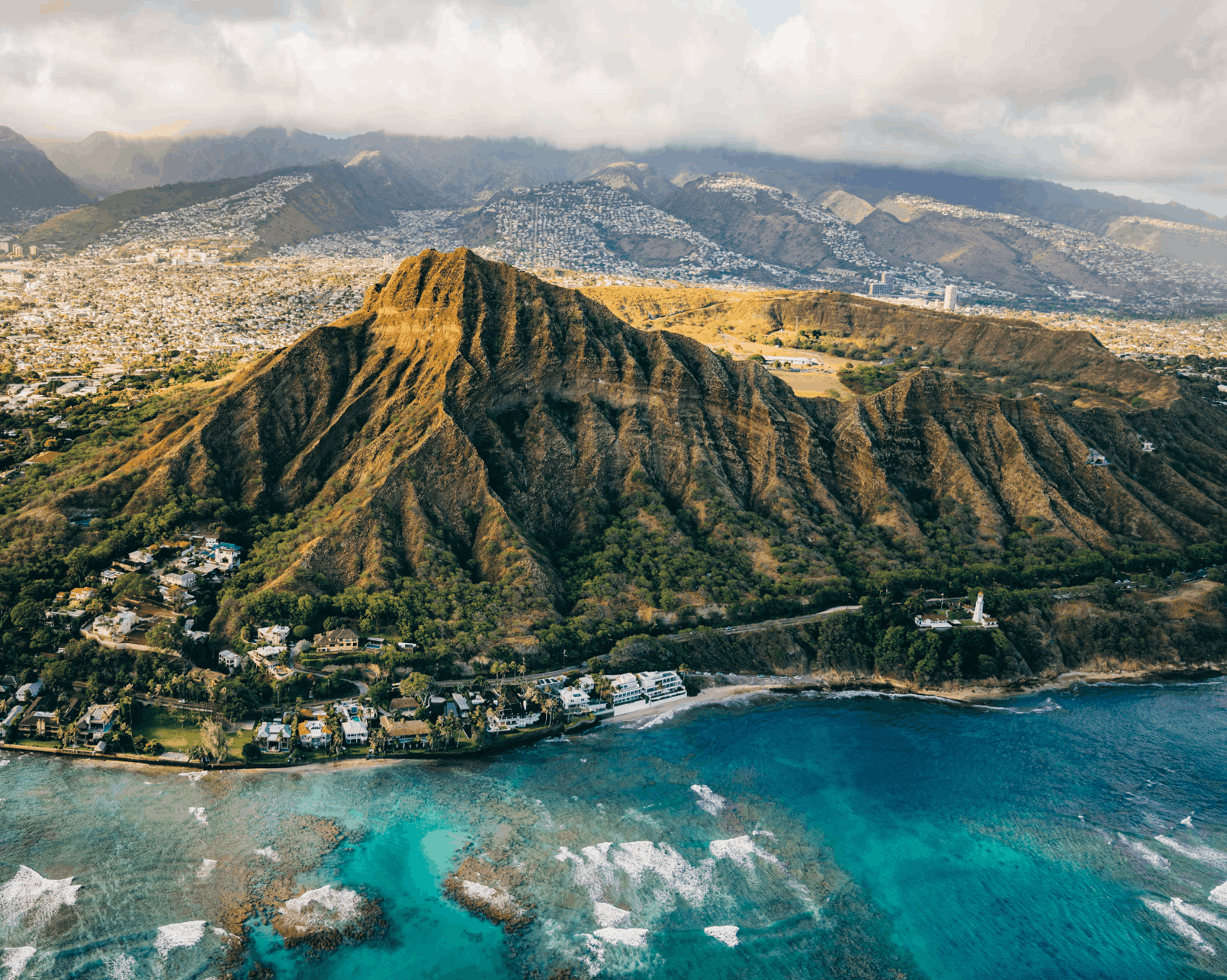
Aerial view of Leʻahi on Oʻahu. Photo by Forest & Kim Starr, 2013. Licensed under CC BY 3.0 US.
When Pele's search for a home reached Oʻahu, different tellings carried her through different parts of the island.
One of the best-documented traditions brings her to Leʻahi, the volcanic crater commonly called Diamond Head today.
Here, Pele dug into the earth once again, searching for a place where her fire could endure. But salt water entered the opening and extinguished her flames. And her search continued onward.
Leʻahi appears repeatedly in recorded Pele traditions, including How Pele Located on Hawaii, Pele Came to Hawaii, and Nathaniel B. Emerson's Pele and Hiʻiaka. The National Park Service also preserves Leʻahi as the place where Pele's attempt to establish her fire was overcome by salt water.
Ka Iwi o Pele — Maui
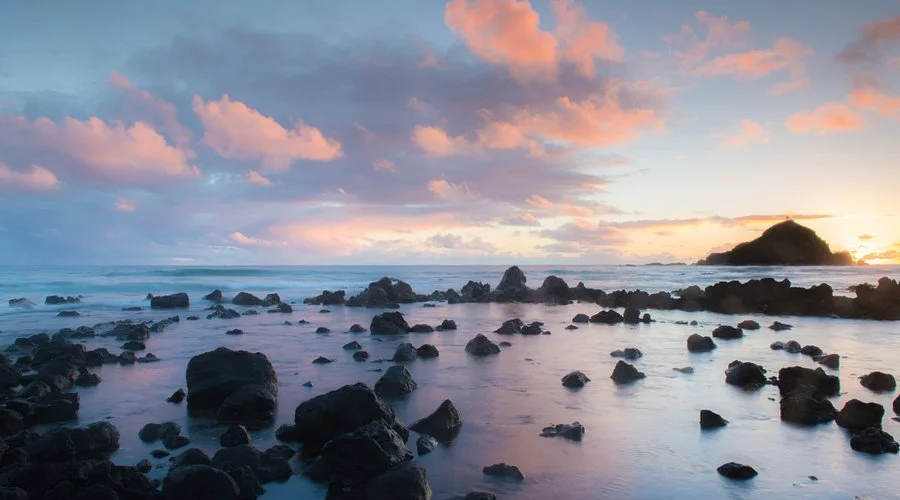
Kōkī Beach near Hāna on Maui, along the coastline associated with Ka Iwi o Pele — “the bones of Pele.” Hawaiian moʻolelo connects this area with the conflict between Pele and her sister Nāmakaokahaʻi.
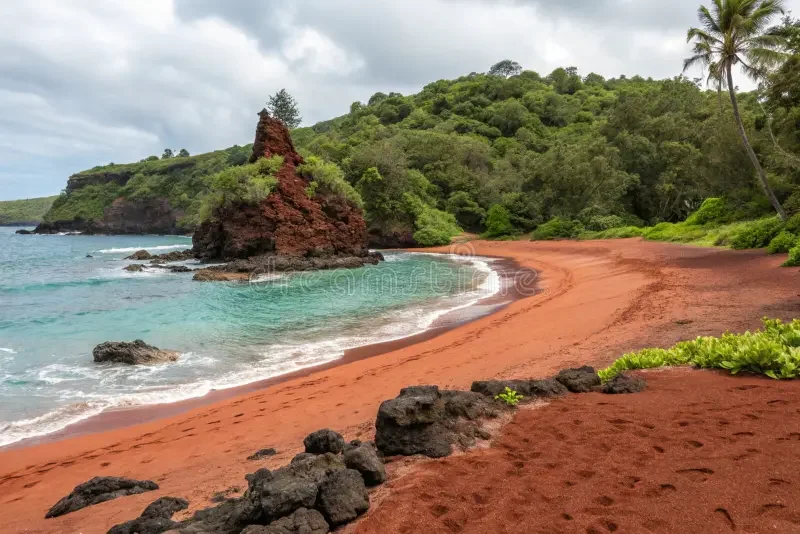
The red cinder shoreline at Kōkī Beach near Hāna on Maui, part of the landscape associated with Ka Iwi o Pele — “the bones of Pele.” Hawaiian moʻolelo connects this place with Pele’s conflict with her sister Nāmakaokahaʻi.
Pele’s journey eventually brought her to Maui, where the landscape itself became part of the moʻolelo surrounding her struggle with Nāmakaokahaʻi.
In one well-known telling, the sisters finally faced one another on the slopes of Haleakalā. Nāmakaokahaʻi tore apart Pele’s physical body, scattering her bones across the volcanic landscape. Pele’s physical form was destroyed, but her spirit continued toward Hawaiʻi Island, where she would eventually make her home at Kīlauea.
Different recorded versions place the physical reminders of this struggle on different parts of Maui. One tradition identifies broken lava formations along the coast of Kahikinui as Nā Iwi o Pele — “the bones of Pele.” Other accounts describe her bones as scattered along Maui’s south and east coasts, and Nā Iwi o Pele is also recorded as the name of a hill near Hāna.
Near Hāna, another recorded tradition preserves the name Ka Iwi o Pele — “the bone of Pele.” In this telling, Pele’s bones were buried near Aleamai and Haneoʻo following a different conflict. This is the landscape near Kōkī Beach shown in the photographs here.
Rather than pointing to a single place as the definitive location of Pele’s bones, these traditions connect different parts of Maui with her presence. Across the moʻolelo, the volcanic landscape becomes inseparable from the story of Pele’s physical form and her continuing journey toward Hawaiʻi Island.
ʻĀloʻi and the Story of Kahawali — Hawaiʻi Island
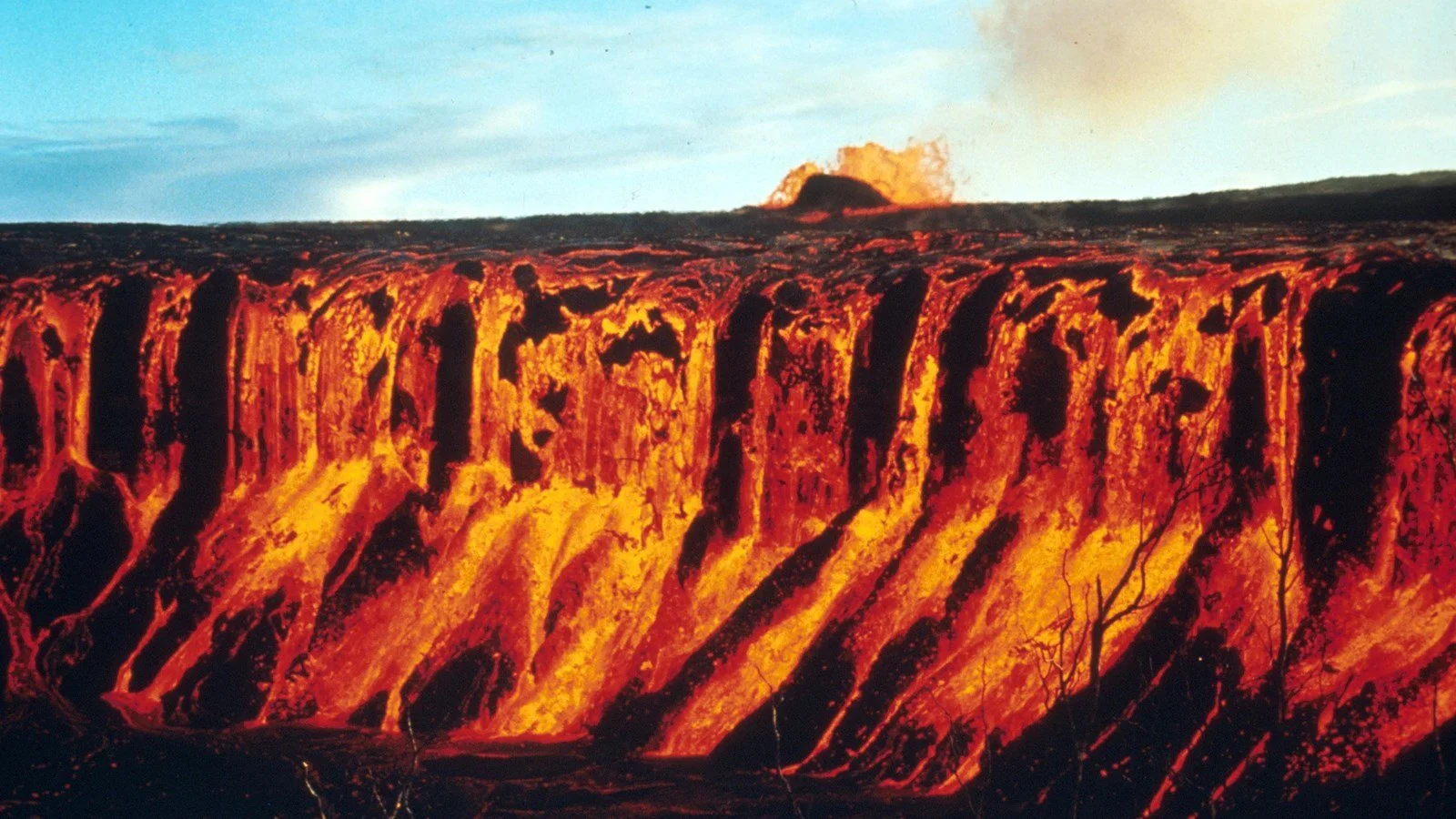
Lava cascading into ʻĀloʻi Crater during the Mauna Ulu eruption at Kīlauea on Hawaiʻi Island. ʻĀloʻi was named for the favorite pig of Kahawali and was later filled by lava during the eruption. Photo by D. Swanson, U.S. Geological Survey. Source: National Park Service.
Earlier, we followed Kahawali as he fled down the slopes of Kīlauea with Pele pursuing him as lava.
As he raced toward the coast, Kahawali passed his home and called out to those he loved. Among them was his favorite pig, ʻĀloʻipuaʻa.
That detail of the story is still connected to the landscape around Kīlauea.
ʻĀloʻi Crater was named for Kahawali's beloved pig. The crater itself was later filled by lava during the Mauna Ulu eruption of 1969–1974, but its name remains.
Another telling continues Kahawali's story after his escape. In that version, he eventually returns to Hawaiʻi Island with a group of powerful priests who intend to challenge Pele at Kīlauea.
They do not defeat her. But several of their names become names on the land around the volcano, including Uēkahuna and Kaʻauea.
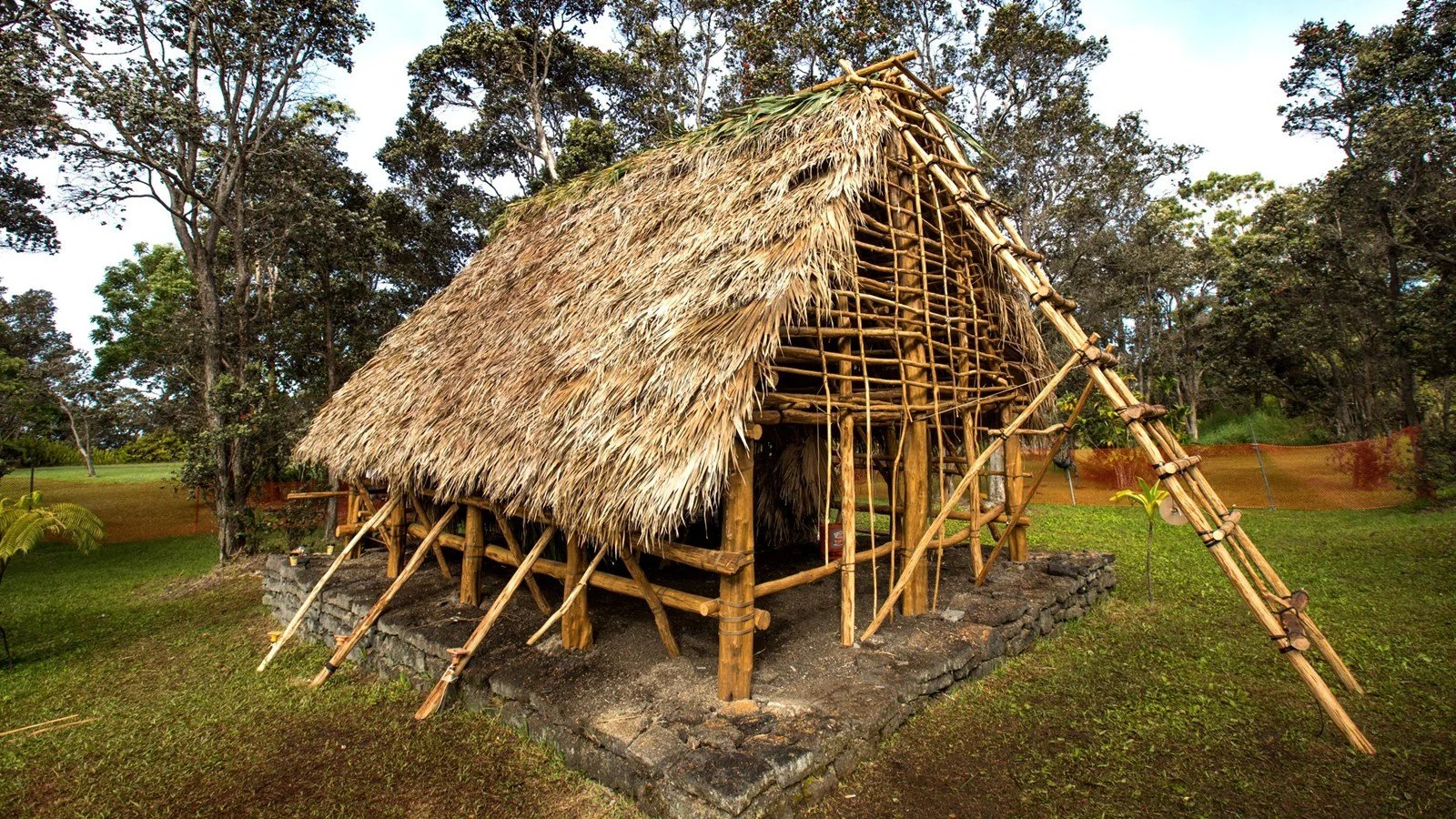
The hale at Kaʻauea on the summit rim of Kīlauea on Hawaiʻi Island. The contemporary hale stands near the kahua hula at a place referenced in Hawaiian chants and oral histories. NPS Photo/J. Wei. Source: National Park Service.
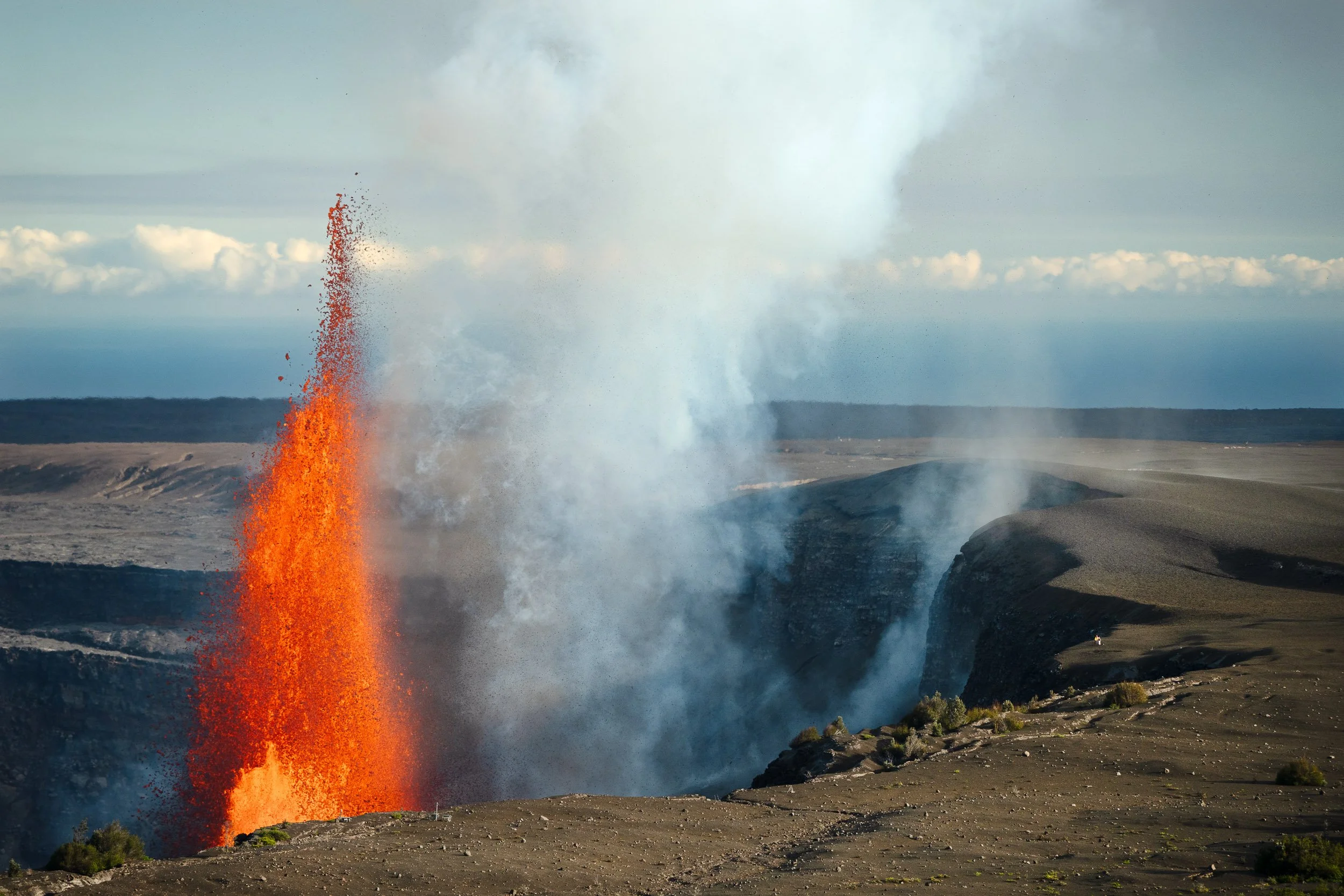
Eruption at Uēkahuna, overlooking Halemaʻumaʻu at the summit of Kīlauea on Hawaiʻi Island. Photograph by Ryan Ikeuchi. Source: Volcano Art Center.
So even after the race is over, pieces of Kahawali's moʻolelo remain around Kīlauea—in the names of places where Pele's presence is still remembered.
Halemaʻumaʻu — The Home of Pele
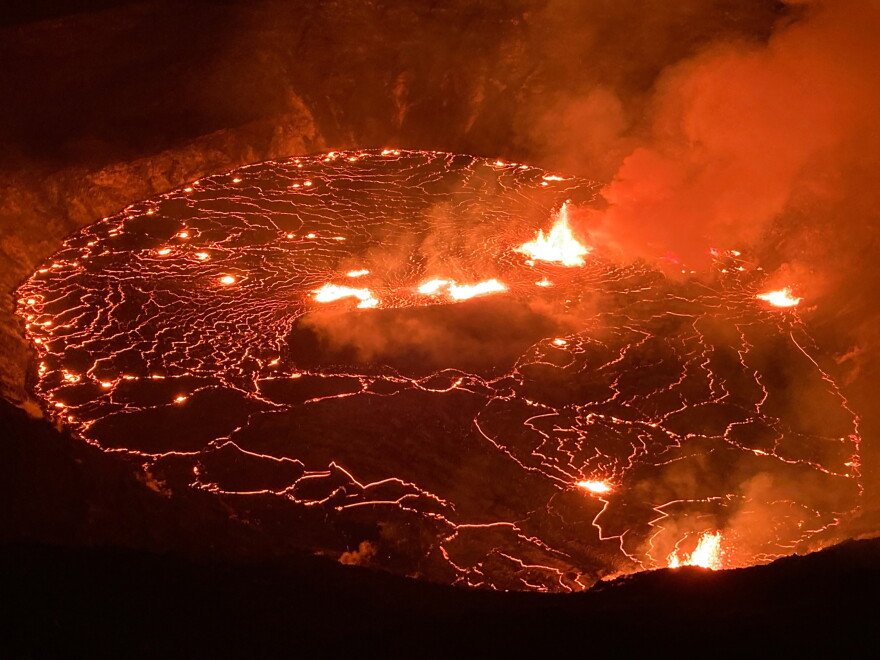
Lava fills Halemaʻumaʻu during the September 29, 2021 eruption of Kīlauea on Hawaiʻi Island. Image courtesy of the U.S. Geological Survey. Source: Hawaiʻi Public Radio / USGS via AP.
And then there is the place toward which Pele's journey has been leading all along. Halemaʻumaʻu at Kīlauea.
Traditional accounts place Pele's enduring home there after her journey through the islands. Hawaiʻi Volcanoes National Park continues to identify Halemaʻumaʻu as her traditional home, while nearby Uēkahuna remains a chosen place for Native Hawaiian cultural practices honoring Pelehonuamea.
Here, the idea of a “sign” begins to feel too small. Within Hawaiian tradition, lava itself can be understood as one of her kino lau—the physical forms through which her presence can be understood in the natural world.
Haleakalā National Park explains this relationship directly: volcanic rock is understood within Hawaiian culture as a physical form of Pele, and lava is among her manifestations.
After the long search from Kahiki, this is where the journey settles. At Kīlauea, Pele is home.
A Relationship With the Land
Knowing these stories changes the responsibility that comes with visiting the places connected to them.
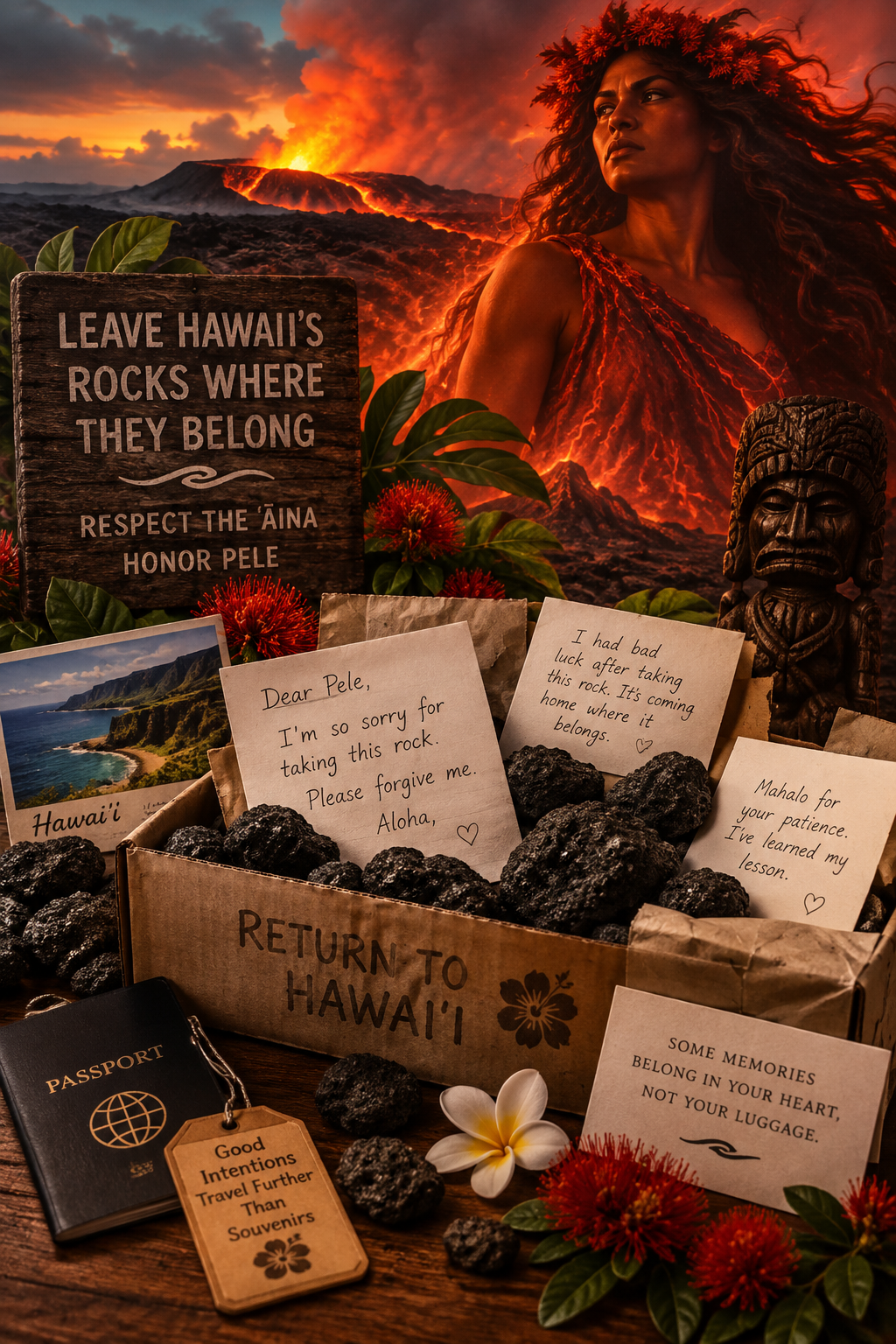
AI-generated image depicting the modern legend of “Pele’s Curse,” including returned lava rocks and apology letters associated with the belief that removing rocks from Hawaiʻi can bring misfortune. Image courtesy of Trilogy Excursions
The ʻāina (land) is not simply beautiful scenery. For people whose traditions understand lava as a kino lau of Pele, volcanic rock carries meaning beyond its appearance. The National Park Service specifically asks visitors not to remove rocks or cinder from Haleakalā out of respect for Hawaiian culture. Removing natural resources from national parks is also prohibited.
Many visitors have heard a different reason for leaving lava rocks behind. “Pele's curse.” The popular story says that anyone who takes lava rock from Hawaiʻi will suffer bad luck until it is returned.
But fear of a curse is not necessary to understand why the rocks should remain where they are. The deeper reason is respect. Lava can be understood as a physical manifestation of Pele. A rock may also belong to a protected landscape or cultural place whose integrity depends upon visitors leaving it undisturbed.
So leave the lava where it rests—not just because you are afraid of invoking Pele’s wrath, but because it belongs to the place.
Learning the moʻolelo connected to the Hawaiian Islands does not give us a greater claim to the places where those stories live. But it does give us a greater kuleana (responsibility) to care for them.